
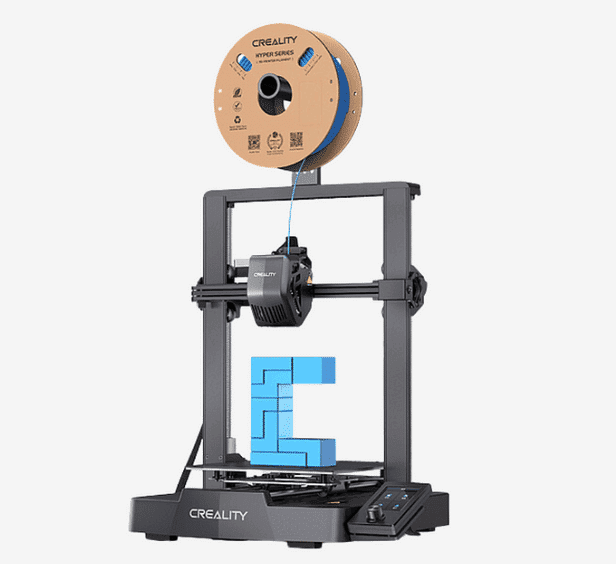
Best beginner choice: For most first-time buyers in South Africa, the Creality Ender 3 V3 SE is the best budget starting point. Choose the Ender 3 V3 KE if you want more speed and a higher-temperature hotend, or the Creality K1 SE if you want a faster CoreXY-style platform with more room to grow. The “best” printer is the one that matches your parts, materials and willingness to learn.
Best beginner 3D printers at a glance
| Printer | Best for | Why beginners choose it |
|---|---|---|
| Creality Ender 3 V3 SE | Lowest-cost FDM start | Automatic bed levelling, direct-drive extrusion and a widely supported platform |
| Creality Ender 3 V3 KE | Faster learning and broader materials | Up to 500 mm/s travel, 300°C hotend, automatic calibration and Wi-Fi control |
| Creality Hi | Taller parts and easy expansion | 260 × 260 × 300 mm build volume and up to 500 mm/s printing |
| Creality K1 SE | High-speed first machine | Fast motion, 300°C hotend and automatic levelling |
| ELEGOO Neptune 4 Pro | Value-focused makers | Klipper-based high-speed printing, 300°C nozzle and automatic levelling |
What should a beginner look for?
Automatic bed levelling
A reliable first layer is more valuable than an impressive maximum-speed number. Automatic levelling reduces setup work, but you still need a clean build surface and the correct first-layer settings.
Direct-drive extrusion
Direct drive can make filament loading simpler and helps when you later experiment with flexible materials. Material compatibility still depends on the hotend, nozzle and printer design.
Available spares and local support
Nozzles and build surfaces are consumables. A printer with locally available spares and people who can help you troubleshoot is usually a safer first purchase than an unfamiliar import.
A build volume that matches your work
Do not buy the biggest machine by default. A standard desktop build volume is enough for many brackets, prototypes and household parts. Large beds take more space and can require more careful setup.
FDM or resin for a first printer?
Choose FDM for functional parts, prototypes, toys, brackets and general learning. Choose resin when very fine detail and smooth surfaces matter, such as miniatures or jewellery masters. Resin printing also requires gloves, cleaning, curing and suitable ventilation, so FDM is usually the simpler all-round start.
What else should you budget for?
- One or two suitable rolls of filament
- Basic hand tools and spare nozzles
- A dry place to store material
- Time to learn slicing, supports and part orientation
- CAD or design help if you do not already have a printable file
Common first-printer mistakes
- Choosing only by the advertised maximum speed
- Buying a machine before deciding what parts and materials it must print
- Expecting downloaded models to print perfectly without slicing adjustments
- Ignoring replacement parts, warranty handling and local support
- Starting with difficult engineering materials before mastering PLA or PETG
Frequently asked questions
How much should a beginner spend?
Roughly R4,600 to R8,500 covers several capable beginner FDM printers in our current range. Keep part of your budget for filament and consumables.
Do I need design experience?
No. You can begin with legal downloadable files and learn CAD later. If you need a custom part, Create It 3D also offers CAD design services.
Can I ask for help choosing?
Yes. Tell us your budget, typical part size, material and intended use, and we will recommend the most suitable options rather than simply the most expensive machine.


