
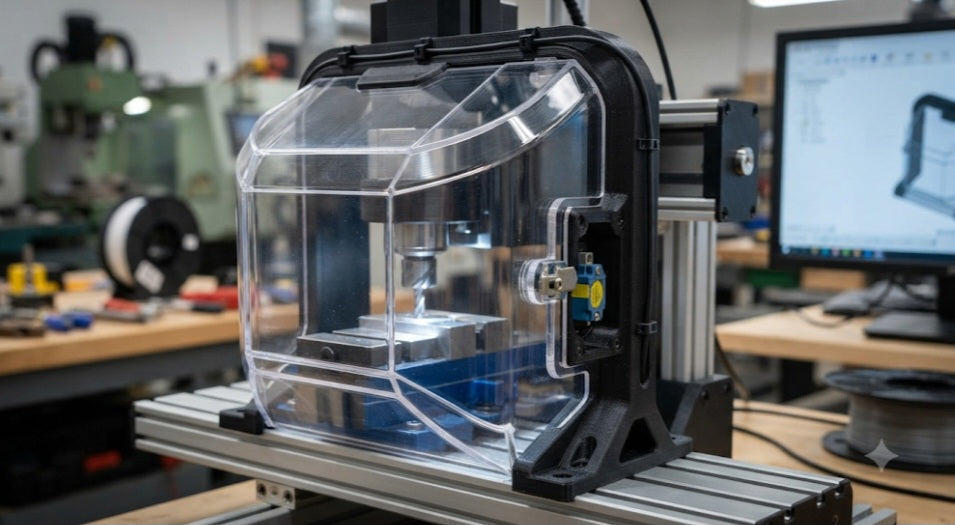
Engineering Custom Safety: Leveraging Large-Scale Additive Manufacturing for Complex Machine Guards, Transparent Impact Shields, and Modular Personnel Interlock Systems
Developing effective safety guarding for bespoke industrial machinery, robotic workcells, and automated assembly lines often requires complex geometries that are difficult and expensive to achieve using traditional sheet metal fabrication or standard extruded aluminum profiles. Conventional fabrication methods frequently result in bulky, obstructed viewing angles or significant design limitations when attempting to integrate safety interlocks, cable routing, or ergonomic operator access points. By utilizing advanced industrial polymer 3D printing, particularly large-format FFF (Fused Filament Fabrication) systems, workshop engineers can rapidly design and fabricate highly customized, application-specific machine guards that conform precisely to the equipment's footprint, ensuring uncompromised safety without sacrificing operational visibility or efficiency.
Complex Geometry and Equipment Conformance
Contoured Enclosures and Shields:
Designing organic, curved, or complex bracket geometries that wrap tightly around pinch points, rotating spindles, or articulated robot arms, providing safety coverage where standard flat guarding cannot fit.
Integrated Mounting and Hardware:
Printing specialized mounting feet, living hinges, and snap-fit attachment points directly into the guard structure, reducing assembly time and eliminating loose fasteners that could vibrate loose.
Transparent Materials and Impact Resistance
Polycarbonate and PETG Integration:
Utilizing high-strength, impact-resistant engineering filaments such as Polycarbonate (PC) or specialized PETG for the main body of the guard to provide a clear, shatterproof barrier that allows operators to monitor processes visually while remaining protected from debris, coolant splash, or unexpected part ejections.
Optimized Wall Thickness and Infill:
Employing variable wall thicknesses and strategic solid sections in high-impact zones, while utilizing transparent infill patterns in lower-risk areas to balance structural integrity with necessary visibility.
Modular Interlock Systems and Ergonomic Access
Integrated Sensor and Switch Pockets:
Designing precision cavities and mounting bosses directly into the printed guard frame to securely house safety interlock switches, magnetic actuators, or RFID safety sensors, ensuring the machine cannot operate unless the guard is properly closed.
Customized Access Panels and Doors:
Fabricating lightweight, custom-hinged access doors and removable service panels with integrated ergonomic handles, allowing for quick maintenance interventions without requiring the complete removal of large guarding sections.
Cable Management and Process Integration
Integrated Wire Channels and Conduit:
Designing hollow internal channels and external cable management clips directly into the guard structure to route sensor cables, pneumatic lines, or LED status lighting wiring cleanly and safely away from moving machine components.
Ergonomic Tool Holders and Accessory Mounts:
Incorporating holders for touch-up tools, stylus pens, or machine status indicator lights onto the exterior surface of the guard, enhancing operator workflow efficiency within the safety cell.
Design-for-Manufacture (DfM) Validation and Stress Testing
Rapid Prototyping of Ergonomic Concepts:
Printing low-cost iterative prototypes of complex guards to test operator line-of-sight, reach distances, and overall ergonomic compatibility before committing to final, functional materials.
Impact and Deflection Testing:
Subjecting printed test samples or full-scale prototype guards to simulated impact forces (e.g., a thrown workpiece or tool failure) to validate that the selected material, wall thickness, and geometry provide the required level of personnel protection.
By integrating these advanced additive manufacturing workflows into the safety design process, engineering teams can rapidly deploy highly customized, durable, and compliant machine guards that not only meet stringent safety regulations but also enhance the functionality and ergonomics of industrial automation systems. The ability to iterate rapidly and integrate complex features directly into the guard structure provides a significant competitive advantage over traditional fabrication methods.


