
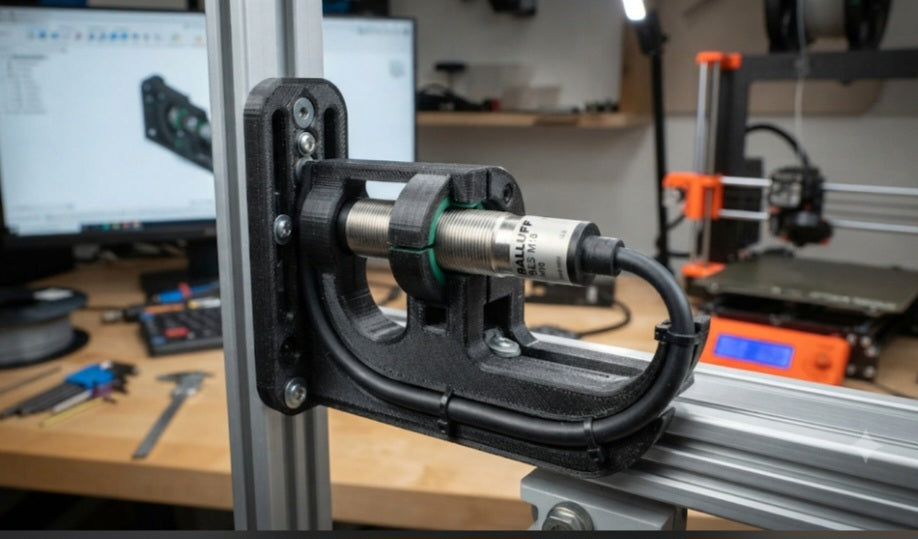
Engineering Precision 3D Printed Custom Sensor Mounts: Optimizing Vibration Isolation, Kinematic Alignment, and Environmental Durability
Designing robust, high-precision brackets and mounts for industrial sensors requires an intricate understanding of mechanical rigidity, dynamic harmonic isolation, and exact spatial tolerancing. Traditional machining of custom metallic brackets from solid aluminum or stainless steel blocks often involves high tooling lead times and significant material waste, rendering iterative design changes costly and slow. By harnessing advanced industrial additive manufacturing, workshop engineers can rapidly prototype and deploy specialized sensor mounts on demand, enabling rigorous bench testing of line-of-sight geometry, fastener preload retention, and vibrational stability before full-scale production.
Kinematic Alignment and Geometric Stability
Exact Spatial Tolerancing:
Engineering rigid mounting geometries and multi-axis adjustment slots directly into the CAD architecture to guarantee repeatable sensor positioning and eliminate angular drift during operation.
Zero-Backlash Clamping Features:
Integrating compliant split-collar designs and integrated clamping jaws that uniformly distribute fastening force around delicate cylindrical sensor bodies without inducing structural distortion or pinching internal circuitry.
Vibration Isolation and Harmonic Damping
Multi-Material Elastic Interfaces:
Designing composite bracket structures that combine rigid structural outer shells with flexible elastomer or TPU dampening pads to isolate sensitive optical and laser distance sensors from heavy machinery vibrations.
Resonant Frequency Tuning:
Structuring internal lattice infills and variable wall thicknesses to shift the natural frequency of the mounting bracket away from the operational excitation frequencies of surrounding industrial equipment.
Thermal Expansion Matching and Material Selection
Low-Thermal-Drift Polymers:
Selecting high-performance engineering filaments such as carbon fiber-reinforced polyamides or PEEK that maintain strict dimensional stability across wide operating temperature fluctuations.
Thermal Isolation Barriers:
Designing air gaps and low-conductivity polymer standoffs between the sensor housing and heated industrial substrates to prevent conductive heat transfer from throwing off calibration.
Environmental Sealing, Corrosion Resistance, and Cable Routing
Integrated Wire Management Channels:
Pre-designing internal conduit pathways, integrated zip-tie anchor loops, and strain-relief radius corners to protect delicate sensor wiring harnesses from mechanical chaffing and tension fatigue.
Corrosion-Resistant Hardware Pockets:
Sinking recessed bolt counterbores and captive nut traps deep within the print body to shield metallic fasteners from corrosive chemical washdowns, moisture accumulation, and aggressive factory atmospheres.
Design-for-Manufacture (DfM) Validation and Mechanical Stress Testing
Static Load and Deflection Audits:
Subjecting fully printed sensor brackets to maximum expected mechanical side-loads and torque limits on testing rigs to verify deflection resistance and structural safety factors.
Field Calibration and Drift Testing:
Performing rigorous cyclic thermal and mechanical shock trials to ensure that sensor alignment remains within sub-millimeter tolerances under continuous operating stress.
Integrating these rigorous pre-production validation methodologies into your additive manufacturing workflow guarantees that every custom sensor mount delivers laboratory-grade measurement accuracy under harsh industrial conditions. By systematically optimizing vibrational damping, thermal stability, and mechanical locking features early in the design phase, engineering workshops can deploy reliable positioning hardware with absolute confidence.


