
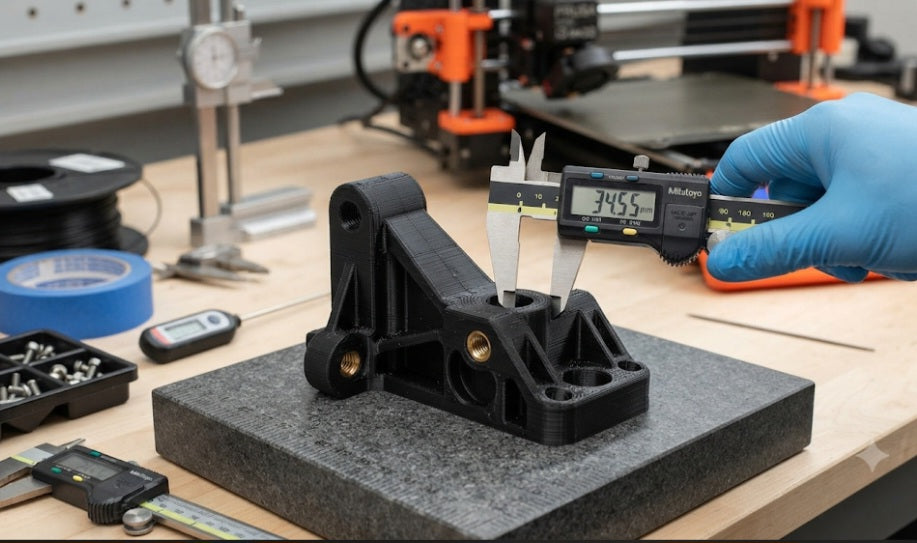
The Ultimate 3D Printing Prototype Testing Checklist: Validating Dimensional Accuracy, Mechanical Fit, and Functional Reliability on the Shop Floor
Moving a digital CAD model into a physical prototype is only half the battle; ensuring that the printed part actually performs under real-world mechanical stress requires a rigorous, systematic evaluation protocol. Unlike traditional manufacturing where material properties are uniform and predictable, fused deposition modeling introduces variables like thermal contraction, anisotropic strength, and layer-to-layer variance that can quietly compromise a functional assembly. Without a standardized verification checklist, workshop professionals risk missing critical assembly clashes, tolerance misalignments, or structural weak points until after final production runs have already begun. For industrial designers and advanced makers, mastering a comprehensive testing workflow is the definitive quality-assurance gateway to repeatable, high-reliability manufacturing.
The Core Validation Pillars of Prototype Testing
Dimensional Accuracy and Geometric Tolerance:
Verifying critical feature lengths, bore diameters, and wall thicknesses against original CAD specifications to catch shrinkage or over-extrusion errors early.
Mechanical Fit and Assembly Kinematics:
Testing the seamless integration of mating parts, including press-fits, snap-joints, hinge clearances, and sliding interfaces, before committing to multi-part print batches.
Structural Integrity and Load-Bearing Capacity:
Assessing how well the prototype handles directional tension, shear stress, and torsional twisting, particularly across vulnerable Z-axis layer lines.
Shop Floor Strategies for Systematic Prototype Auditing
Utilizing Precision Measurement Tools:
Standardize your inspection routine by using digital calipers and micrometers to measure hole diameters, wall thicknesses, and hole-to-hole center distances across multiple axes.
Executing Dry-Fit Test Assemblies:
Never force mating components together; perform manual dry-fits to evaluate friction levels, snap-fit deflection resistance, and hardware alignment for captive nuts and threaded inserts.
Documenting Failure Modes Under Load:
Apply progressive mechanical stress or drop-testing to your structural prototypes, meticulously logging where and how layers delaminate or fracture to inform subsequent CAD design iterations.
For ultimate assurance in demanding operational environments, consider subjecting your final prototype iterations to thermal cycling tests or sustained vibrational loads before green-lighting full-scale manufacturing batches. Because environmental exposure and continuous mechanical fatigue can expose hidden micro-cracks in thermoplastic matrices, pre-screening your parts under simulated stress conditions ensures your assemblies deliver uncompromising structural longevity.
Ultimately, implementing this rigorous auditing checklist transforms trial-and-error printing into a predictable, engineering-driven production workflow.


