
Engineering High-Strength Screw Holes in 3D Printed Parts: Thread Reinforcement, Boss Optimization, and Shear Stress Distribution
Directly driving self-tapping screws into raw thermoplastic layers is one of the quickest ways to cause premature joint failure in functional 3D printed assemblies. Unlike homogeneous metals or injection-molded engineering plastics, fused deposition modeling creates parts with inherent directional weakness; screws driven parallel to layer lines will easily strip out under minimal tensile pull, while unreinforced bosses split wide open from radial hoop stresses. For workshop professionals and industrial designers, mastering how to properly reinforce screw holes—through heat-set brass inserts, structural boss geometry, and optimal perimeter counts—is essential for creating durable, reusable mechanical joints that can withstand heavy fastening torque and continuous operational vibration.
The Mechanics of Thread Retention in Additive Manufacturing
Layer Orientation and Tensile Pull-Out:
Fasteners threaded perpendicular to the Z-axis rely purely on fragile interlayer adhesion to resist pull-out forces, whereas screws aligned parallel to the layers shear across solid plastic extrusions.
Radial Expansion and Boss Hoop Stress:
Tightening a screw creates an outward wedging force; thin-walled bosses lack the structural rigidity to contain this pressure, resulting in radial micro-cracks that compromise the entire fastener seat.
Thermal Anchoring Dynamics:
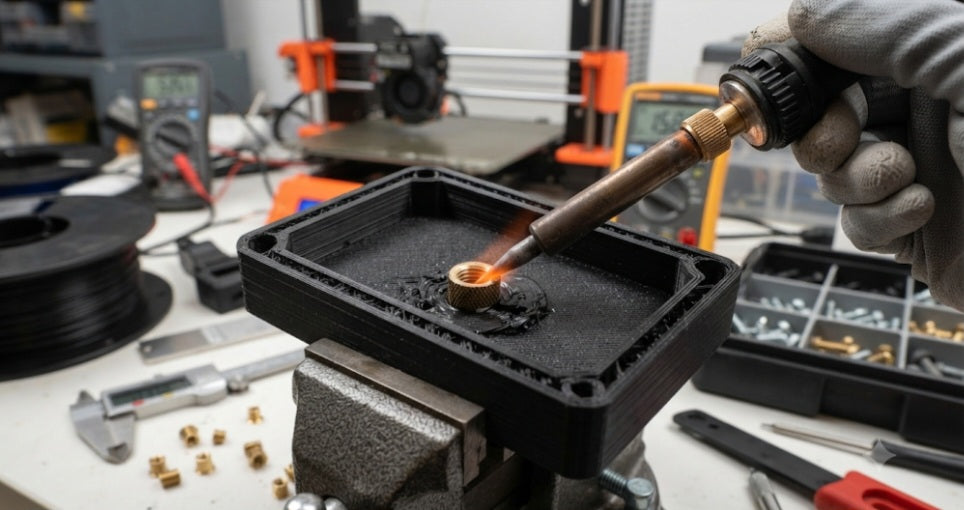
Heat-set brass inserts utilize localized thermal energy to melt a precise pocket of polymer, allowing the knurled brass teeth to lock permanently into the surrounding matrix upon cooling.
Shop Floor Strategies for Bulletproof Screw Joints
Designing Robust Boss Wall Thickness:
Program your CAD model and slicer settings to provide at least three to four solid perimeters and dense structural infill around any screw boss to absorb high radial clamping loads.
Optimizing Heat-Set Pocket Tolerances:
Size your insert holes with a precise diametric clearance—typically matching the manufacturer's recommended pilot hole minus a fraction of a millimeter—to ensure the brass insert melts flush without tilting or displacing surrounding walls.
Implementing Metal Inserts for High-Cycle Reusability:
Avoid direct plastic threads for parts that require frequent disassembly; instead, standardize on brass threaded inserts to distribute torque loads across a much larger surface area.
For ultimate longevity under severe mechanical stress, consider pairing your heat-set brass inserts or threaded bosses with structural metal backing plates or split lock washers. Because continuous operational vibration can slowly back screws out of thermoplastic housings over extended duty cycles, introducing mechanical locking elements ensures your fasteners stay firmly torqued without transferring destructive harmonic resonance back into the printed matrix.
Integrating these engineering safeguards transforms weak plastic connection points into resilient, industrial-grade mechanical assemblies capable of withstanding heavy daily use.


