
Beyond the Mesh: How Modern Additive Manufacturing is Evolving Past STL Files and What It Means for Your Workflow
For as long as desktop and industrial 3D printing have been part of the modern manufacturing landscape, the humble STL file has reigned supreme. From the earliest days of rapid prototyping to complex production bureaus, exporting your computer-aided design (CAD) model into a standard triangle language mesh has been the universal bridge between digital creativity and physical reality. But this decades-old file format—born in an era of primitive computing—comes with inherent flaws that are increasingly difficult to ignore in high-precision engineering environments.
When you convert a smooth, mathematically precise parametric curve into a coarse or even ultra-dense web of flat triangles, you sacrifice fidelity. You introduce file bloat, potential non-manifold geometry errors, and a loss of granular metadata that modern additive manufacturing systems desperately need. Fortunately, the industry is shifting toward more intelligent, direct workflows that bypass the STL bottleneck entirely, opening up new horizons for designers, engineers, and creators who demand absolute precision.
The Limitations of the Triangle Mesh and the Rise of Modern Alternatives
Relying exclusively on surface tessellation creates roadblocks that cost valuable time during the pre-production and slicing phases:
The Tessellation Trap and Curve Degradation:
Because STLs approximate smooth surfaces using interconnected triangles, you are always forced to compromise between manageable file sizes and surface smoothness. Step up the resolution to get a clean print, and your slicing software bogs down processing massive, multi-gigabyte meshes.
Loss of Parametric and Material Metadata:
An STL file only knows coordinates and surface normals; it carries zero information about internal material densities, color gradients, stress loads, or multi-material allocations. This forces engineers to rely on external documentation and manual adjustments.
Adopting AMF and 3DMF Formats:
Modern manufacturing workflows are increasingly embracing advanced formats like the Additive Manufacturing File (AMF) and 3D Manufacturing Format (3DMF). These newer standards retain true curved geometries, support multiple materials within a single file, and embed color and structural metadata natively.
Direct CAD-to-Slicer Integration:
Many high-end slicing suites now interface directly with native CAD kernels (such as STEP or Parasolid). By eliminating the export-to-STL step entirely, you retain exact mathematical tolerances, ensuring that bolt holes remain perfectly round and mating surfaces align without conversion artifacts.
Streamlining Production with Direct Data Pipelines
Moving away from legacy mesh formats is not merely an academic exercise; it represents a fundamental upgrade to how custom manufacturing bureaus and digital creators operate. By streamlining the data pipeline from native CAD directly to the production floor, you eliminate translation errors, reduce file preparation overhead, and unlock advanced multi-material capabilities that were previously impossible with basic triangular meshes.
The Horizon of 3D Printing Protocols:
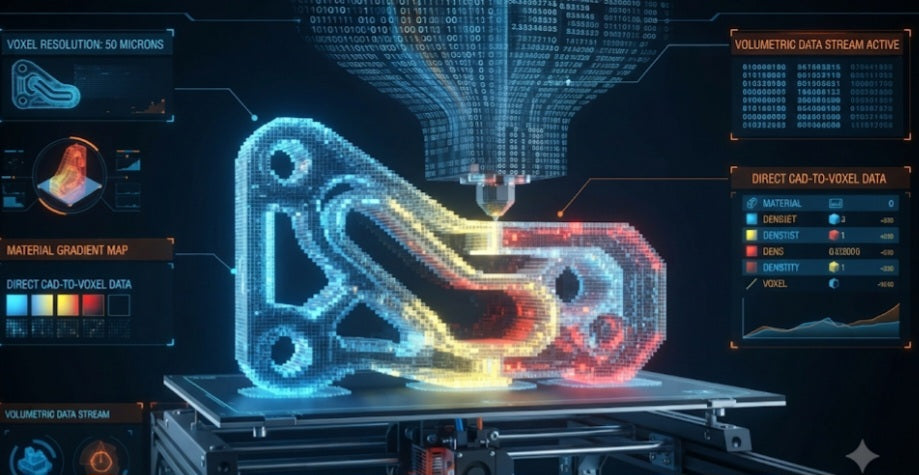
Beyond native CAD and AMF files, the future of meshless manufacturing is moving toward voxel-based printing and volumetric modeling. Instead of calculating vector geometry or surface triangles, voxel printing treats digital models as 3D pixels that can hold distinct instructions for local density, gradient elasticity, and microscopic material composition across every single cubic millimeter of the build.


