
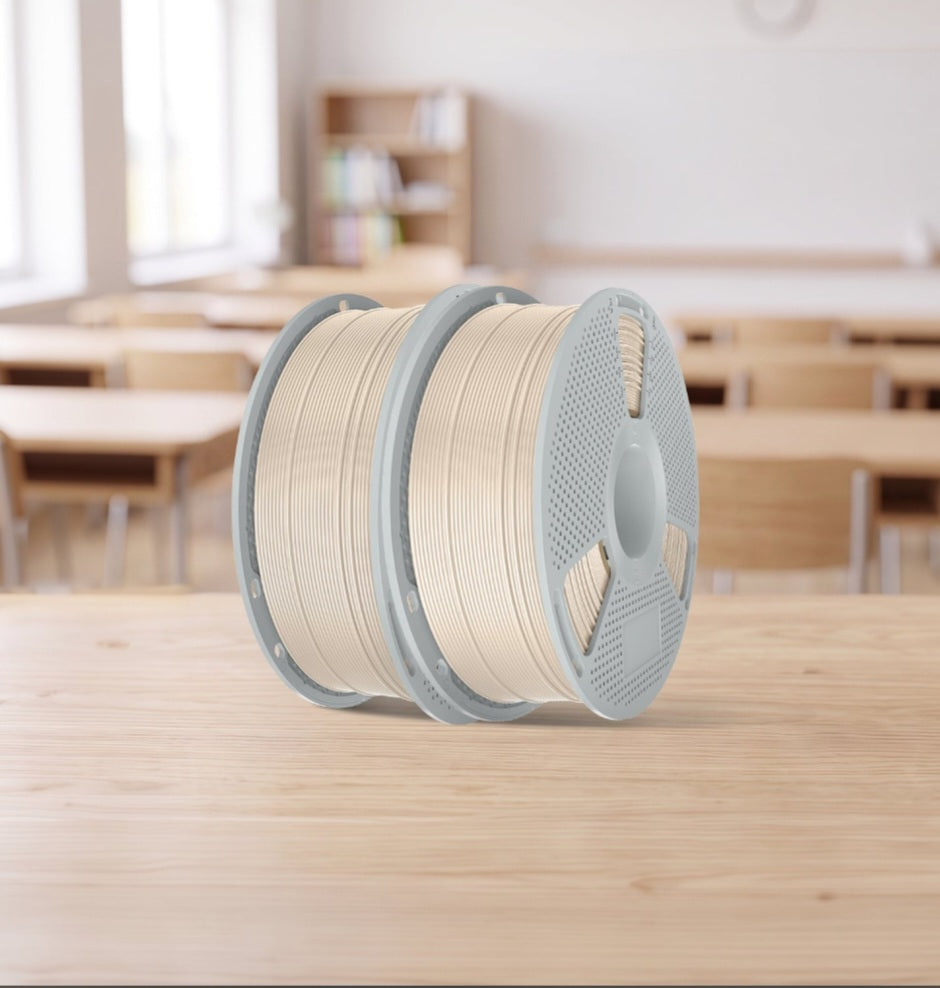
Engineering Thermal Resilience: Choosing the Best High-Heat 3D Printing Materials for Extreme Industrial Applications
Pushing additive manufacturing past standard prototyping limits requires mastering materials that can withstand punishing thermal environments without losing structural integrity. When your Shopify store clients in Durban and across South Africa demand functional components, motor housings, or high-temperature jigs that operate under extreme heat, selecting the correct polymer is critical. Using the wrong plastic results in catastrophic thermal creep, sagging, and structural failure under load.
Top High-Temperature Thermoplastics for Extreme Thermal Performance
PEEK (Polyether Ether Ketone):
Undisputedly the gold standard for demanding aerospace, automotive, and industrial machinery parts. PEEK boasts a glass transition temperature of around 143°C and a continuous-use rating up to 260°C, offering exceptional chemical resistance and unmatched strength-to-weight ratios that easily justify its investment in Rands for elite applications.
PEI (Ultem 9085 / 1010):
Widely utilized in aerospace and heavy manufacturing, Ultem delivers outstanding flame retardancy, low smoke emission, and high heat deflection temperatures exceeding 200°C under load. It provides a phenomenal stiffness-to-weight profile for demanding functional components.
Polycarbonate (PC):
An accessible yet rugged choice for medium-to-high heat applications. Standard engineering-grade polycarbonate handles continuous thermal exposure up to 110°C to 120°C with exceptional impact resistance, preventing parts from shattering under sudden mechanical stress.
High-Temperature Formulated Carbon Fiber Nylons (PAHT-CF):
While standard nylons absorb moisture and soften under heat, advanced high-temp variants reinforced with carbon fiber maintain their dimensional stability and structural rigidity at elevated ambient temperatures, making them brilliant for under-the-hood automotive brackets.
Critical Thermal Metrics Every Workshop Must Understand
Heat Deflection Temperature (HDT):
Measures the precise temperature at which a polymer deforms under a specified load, giving you a realistic baseline for structural parts under stress.
Glass Transition Temperature (T_g):
The point at which an amorphous or semi-crystalline polymer transitions from a hard, rigid state into a softer, rubbery material.
Continuous Use Index (CUI):
Indicates the maximum temperature a material can endure over thousands of hours of operation without significant degradation of its mechanical properties.
Balancing these thermal tolerances against material input costs in ZAR ensures your shop delivers components built for longevity. What specific high-heat operating temperatures will your next batch of machine parts face on the factory floor?
Post-Processing and Annealing Strategies for Maximum Thermal Endurance
Achieving peak performance from high-temperature prints requires more than just selecting the right engineering filament; it demands precise thermal post-processing. Semi-crystalline polymers like PEEK and specialized high-temp nylons benefit immensely from a controlled annealing process. By heating printed components in an industrial laboratory oven just below their glass transition temperature and allowing them to cool down gradually, internal residual stresses generated during rapid layer extrusion are relieved. This thermal treatment increases crystallinity, locking in superior dimensional stability, higher tensile strength, and maximum heat deflection temperatures.
Hardware Requirements for High-Heat Extrusion
Enclosed Heated Chambers:
Printing ultra-polymers like PEEK requires an actively heated build chamber capable of maintaining ambient temperatures between 90°C and 200°C to prevent catastrophic part warping and interlayer delamination.
All-Metal High-Temp Hotends:
Standard PTFE-lined hotends degrade and release toxic fumes at temperatures above 240°C, meaning a robust all-metal hotend capable of reaching 450°C is mandatory.
Hardened Steel Nozzle Assemblies:
Abrasive high-temp carbon fiber or glass-filled filaments will rapidly chew through standard brass nozzles, requiring hardened steel or tungsten carbide components to maintain precise extrusion tolerances.


