
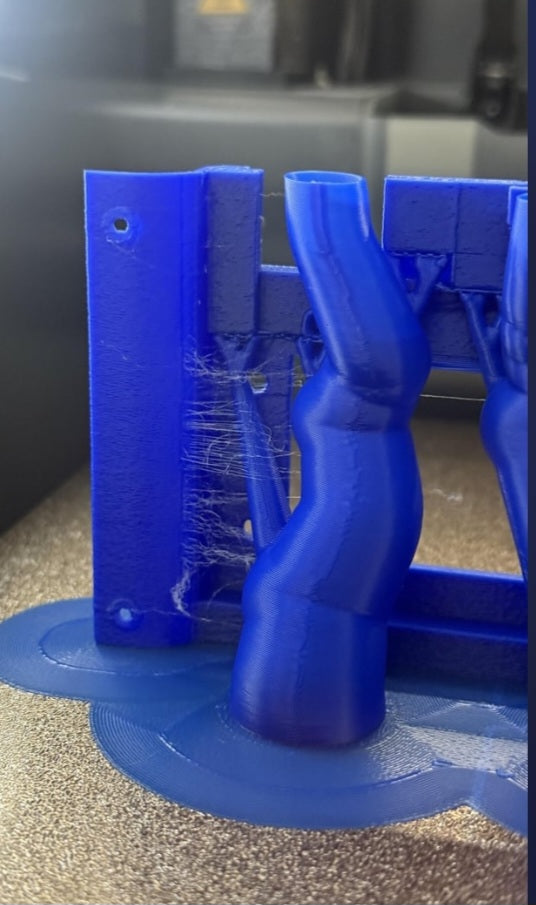
Wet filament doesn't just "affect" a print; it can absolutely ruin it. Because 3D printing relies on precise extrusion, even a small amount of trapped moisture can sabotage the structural integrity, surface finish, and overall success of your project.
How Wet Filament Ruins Prints
Destroys Surface Quality: As the filament heats up, the trapped water turns to steam, creating micro-explosions at the nozzle tip. This results in fuzziness, blobs, bubbles, and craters on the surface, ruining the clean, professional look of your parts.
Causes Severe Stringing: Wet material often has a lower viscosity than dry material. It doesn't "break" cleanly when the printer moves between points, leading to excessive hair-like strings that can be difficult or impossible to clean up post-print.
Compromises Structural Integrity: This is the most dangerous effect. If the filament is popping due to moisture, those tiny gaps and bubbles create weak points inside the layers. This can cause part delamination (layers separating) or lead to parts that snap under the slightest pressure.
Leads to Clogs and Jams: Over time, the inconsistent flow of wet filament can cause residue to build up inside the hotend. This can lead to frequent under-extrusion, nozzle clogs, and failed prints halfway through a long build, wasting both your time and expensive material.
Ruins Dimensional Accuracy: Since the steam expands and pushes plastic out inconsistently, your parts may suffer from poor dimensional accuracy. This is critical if you are printing functional parts that need to fit together (like enclosures or gears).
The "Cost" of Ignoring Moisture
When you print with wet filament, you aren't just getting a "lesser" print—you are risking a total failure.
Waste: A spool of filament is an investment, and if you use a wet, degraded spool for a 20-hour print that ultimately fails, you've wasted electricity, filament, and the wear-and-tear on your machine.
Frustration: There is nothing more disheartening than returning to your printer after a long day to find a "spaghetti mess" or a brittle, ugly print that needs to be tossed in the bin.
In the end, printing with wet filament is a gamble that rarely pays off. By allowing moisture to interfere with your extrusion, you risk everything from frustrating surface defects and excessive stringing to total structural failure of your parts. These issues don't just compromise the aesthetics of your work; they waste your time, your electricity, and your hard-earned material.
Don't let a damp spool turn your passion project into a failed experiment. By recognizing the warning signs and taking the time to dry your filament before it hits the print bed, you protect your investment and ensure every piece you pull off the plate is as strong and professional as it should be. A little preventative maintenance goes a long way toward keeping your 3D printing experience stress-free and successful.


