
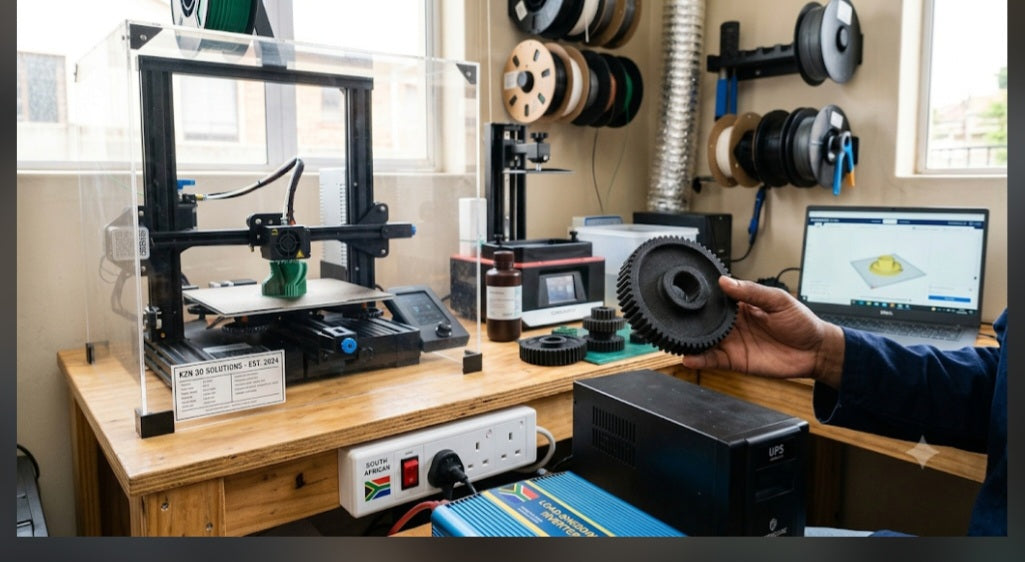
Before investing in a 3D printer for your business, it is important to look beyond the initial purchase price and consider the long-term operational requirements and "hidden" costs.
Essential Considerations for Business
Total Cost of Ownership: Don't just budget for the machine itself; factor in ongoing expenses like filament (roughly R15 to R40 per hour depending on usage), electricity, spare parts (nozzles, build plates), and potential service agreements.
Reliability & Downtime: For a business, reliability is key to avoiding wasted material and time. Professional-grade machines with automated features—like bed leveling and failure detection—often save money in the long run by reducing the need for constant "fiddling" or re-prints.
Environment & Safety: Consider where you will operate the printer. If you are printing with materials like ABS or Nylon, you will need a fully enclosed printer with a filtration system (HEPA/carbon) to manage air quality and maintain consistent temperatures, especially in a non-ventilated room.
Technical Skills & Support: Success requires proficiency in CAD software (like Fusion 360) and an understanding of "slicing" software to generate instructions for your printer. Purchasing from a local South African supplier is highly recommended to ensure you have access to quick technical support and readily available replacement parts.
Key Technical Basics
The Workflow: 3D printing is an additive process where an object is built layer-by-layer from a digital file. The process involves designing or downloading a 3D model, "slicing" it into layers to create G-code, and then monitoring the print.
Material Selection: Different materials have different strengths and requirements. For example, PLA is standard for beginners, while ABS or ASA are better for functional or high-temperature parts but require more robust equipment.
Maintenance: Even reliable printers require regular upkeep, such as cleaning nozzles, lubricating axles, and checking belt tension, to ensure consistent quality and prevent mechanical issues.
Remember that the most successful 3D printing businesses are built on a foundation of consistent quality and reliable production rather than just the flashiest machine. By planning your budget to include power protection and maintenance, you set yourself up for long-term stability.
Prioritizing a machine that matches your specific production goals and leaning on a local South African supplier for support positions you to scale steadily. Stay organized and focus on delivering parts that work exactly as promised to keep your customers coming back.


