
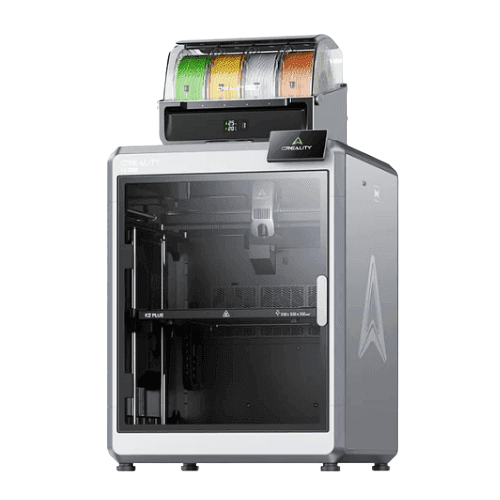
Best small-business choice: There is no single winner for every company. For dependable engineering prototypes, shortlist the Creality K1C or ELEGOO Centauri Carbon 2. For multicolour products, compare the FlashForge AD5X and Creality CFS bundles. For large parts, consider the Creality Ender 5 Max, K2 Plus or ELEGOO OrangeStorm Giga.
Choose by the work that earns revenue
| Business need | Recommended shortlist | Why |
|---|---|---|
| General prototypes and functional parts | Creality K1C, ELEGOO Centauri Carbon 2 | Fast enclosed platforms suited to daily workshop use |
| Multicolour products | FlashForge AD5X, Creality Hi Combo, Creality K2 Combo | Integrated material-changing options for finished products and visual prototypes |
| Large FDM parts | Creality Ender 5 Max, K2 Plus, ELEGOO OrangeStorm Giga | Larger build volumes for props, tooling and oversized prototypes |
| Fine-detail resin work | ELEGOO Saturn 4 Ultra 16K, ELEGOO Jupiter 2 | High detail, with Jupiter 2 adding large-format resin capacity |
| Industrial controlled production | FlashForge Creator 4A, Raise3D Pro3 HS | Professional platforms for repeatable business workflows |
Our practical recommendations
Best all-round engineering shortlist
The Creality K1C offers an enclosed 600 mm/s platform, 300°C hotend, automatic levelling and AI camera. The ELEGOO Centauri Carbon 2 is another strong option for high-speed prototypes and production. Decide between them using material support, build size, spares and the workflow your team prefers.
Best for multicolour products
The FlashForge AD5X, Creality Hi Combo and Creality K2 Combo serve different budgets and build requirements. Multicolour printing adds purge material and setup considerations, so calculate material waste and job time into your selling price.
Best for large parts
The Creality Ender 5 Max provides a 400 × 400 × 400 mm build volume. The K2 Plus adds an enclosed 350 mm platform and high-temperature capability, while the OrangeStorm Giga targets genuinely oversized work. Confirm that your real parts need the extra volume; large beds consume more space and material.
One expensive printer or several smaller printers?
Several identical smaller printers can give a print farm redundancy and parallel throughput. One larger professional printer may offer better material control, enclosure and process consistency. Compare the value of uptime: if one machine failure stops every order, redundancy may matter more than headline speed.
Calculate return on investment before buying
- List the parts or products you will sell
- Estimate successful prints per week, not theoretical maximum output
- Include material, supports, failed jobs, labour, maintenance and payment fees
- Set a selling price that covers design and customer service
- Decide who owns printer operation and quality control
- Plan spare nozzles, build surfaces and backup capacity
Questions to answer before choosing
- What is the largest real part you expect to print?
- Which materials are essential?
- Do you need an enclosure or multicolour?
- How many production hours will run each week?
- What happens when the machine is down?
- Do you need local support, installation or training?
Create It 3D sells and uses 3D printing equipment for real customer work. Share your application, budget and output target, and we can help narrow the shortlist.


