
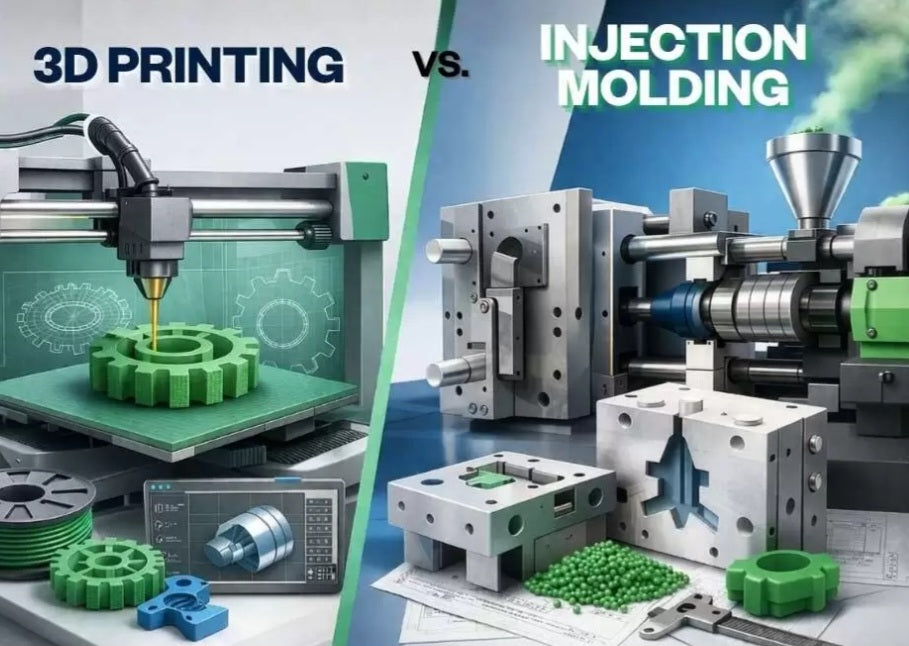
Transitioning from Additive Prototyping to Industrial Injection Moulding: Identifying the Economic and Structural Thresholds for Tooling Investment
Shifting a developed component from additive manufacturing or short-run stereolithography to high-volume injection moulding is one of the most critical financial and operational decisions an industrial workshop can face. While 3D printing offers unmatched geometric freedom and rapid design iteration during the early stages of product development, it eventually hits economic and structural ceilings when scaling to commercial volumes.
Understanding the exact inflection point—where per-unit material costs, cycle times, and structural isotropically demanding applications justify the high initial capital expenditure of steel or aluminium tooling—is essential for maintaining profitability and engineering integrity.
Economic Thresholds and Volume Break-Even Analysis
Per-Unit Material Cost Crossover:
Identifying the production volume where the cumulative cost of expensive engineering filaments or resins surpasses the amortised cost of custom injection mould tooling and high-volume thermoplastic pellets.
Labor and Post-Processing Overhead:
Factoring in the hidden expenses of additive manufacturing scale, such as support removal, sanding, chemical smoothing, and manual insert placement, which become financially unsustainable at scale.
Cycle Time Efficiency:
Comparing the hours required to build parts layer-by-layer on a print farm against the seconds-per-part injection cycle of an automated moulding press.
Structural and Material Validation Requirements Before Tooling
Material Equivalence Verification:
Ensuring that the chosen production polymer (such as glass-filled ABS, polycarbonate, or nylon) matches the mechanical performance parameters established during physical prototype stress testing.
Draft Angles and Wall Thickness Optimization:
Re-designing internal ribs, bosses, and exterior walls to meet the strict draft angle, uniform thickness, and shrinkage compensation requirements inherent to high-pressure mould filling.
Thermal and Environmental Stress Compliance:
Confirming that prototype validation data accounts for real-world injection moulding phenomena, such as weld lines, gate locations, and residual thermal stresses.
Committing to custom tooling without verifying structural reliability under actual operational loads can lead to catastrophic financial loss if mould modifications are required post-machining. By establishing rigorous volume targets and finalizing design-for-manufacture guidelines during the final prototype phase, industrial workshops can transition smoothly from desktop fabrication to high-volume commercial production.
Beyond initial tooling and volume metrics, evaluating mold life expectancy and maintenance schedules is crucial for long-term production viability. High-volume industrial molds machined from hardened tool steel can withstand hundreds of thousands of cycles, but require planned downtime for cleaning and parting-line inspections to prevent flashing and dimensional drift. Integrating these operational maintenance protocols early ensures that the financial benefits of high-volume production are fully realized across the entire lifespan of the tool.


