
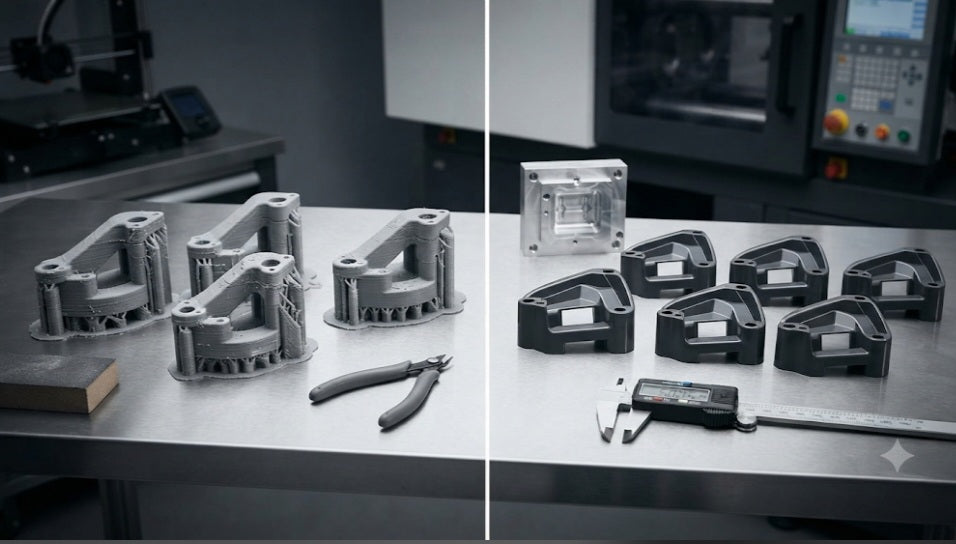
Utilizing Additive Manufacturing as a Bridge Production Strategy: Mitigating Risk and Securing Market Entry Before Full Tooling Investment
Bridging the gap between initial digital validation and high-volume commercial manufacturing represents a pivotal operational hurdle for modern industrial workshops. While traditional product development pathways often force a premature, high-risk leap from desktop 3D printing directly into expensive steel tooling, bridging the production gap with advanced additive manufacturing allows enterprises to fulfill live market demand, test real-world user feedback, and generate immediate revenue. This transitional strategy ensures that engineering flaws are identified and corrected under actual operating conditions before capital is locked into permanent hard tooling.
Financial and Market
Validation
Advantages
Mitigating Capital Expenditure Risk:
Delaying massive steel tooling investments until product-market fit and design stability are definitively confirmed through live commercial sales.
Accelerated Time-to-Market:
Bypassing the weeks or months required for core-and-cavity mould machining, allowing immediate batch delivery using high-speed industrial polymer printing farms.
Continuous Design Agility:
Implementing rapid engineering revisions on the fly without incurring thousands of dollars in costly mould rework or EDM modifications.
Operational Challenges in Scale Additive Production
Anisotropic Mechanical Behavior:
Accounting for directional strength disparities inherent in layer-by-layer deposition when producing end-use commercial components.
Post-Processing Bottlenecks:
Managing the labor-intensive requirements of support removal, vapor smoothing, and surface finishing when scaling additive output past single-digit batches.
Per-Part Cost Stability:
Factoring in constant filament or resin consumable expenses that do not enjoy the exponential unit-cost drops seen in high-pressure moulding.
Deploying a bridge production phase requires balancing throughput velocity against material performance limitations. By leveraging high-end industrial systems—such as high-speed multi-laser sintering or reinforced filament extrusion—workshops can successfully supply early adopters while finalising their downstream mass-production parameters. Furthermore, establishing a strict revision-control matrix during this bridge phase ensures that digital CAD files match the physical reality of the manufactured batches, preventing costly discrepancies when the data is finally handed over to the injection moulding supplier.
Furthermore, establishing strict post-processing and quality control frameworks during bridge production—such as utilizing non-destructive testing, optical CMM scanning, and controlled thermal treatments—ensures that transitional components meet exact engineering standards before final high-volume tooling commences.


