
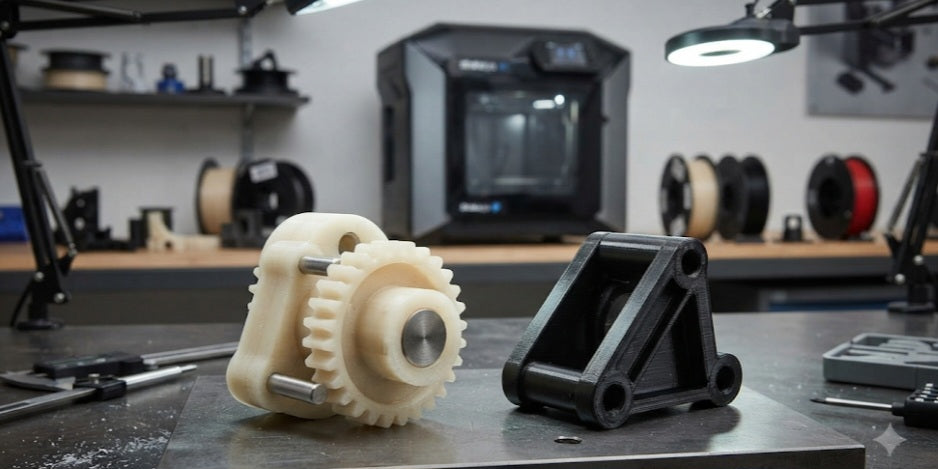
Engineering Resilience: When to Choose Nylon Over PETG for Heavy-Duty 3D Printed Industrial Parts
Selecting the right polymer for demanding industrial applications often comes down to balancing impact resistance, friction coefficients, and operational load limits. While standard polyethylene terephthalate glycol (PETG) serves as an exceptional, easy-to-print baseline material for general-purpose enclosures and brackets, it hits strict performance ceilings under continuous mechanical friction, heavy cyclic stress, or elevated thermal environments. When your workshop builds functional end-use parts that must endure severe mechanical abuse, upgrading to neat or reinforced polyamide (nylon) provides the necessary toughness and wear resistance.
Molecular Structure and Mechanical Deficiencies of Standard PETG
Creep and Stress Relaxation:
Under sustained constant loads over long operational lifespans, PETG components suffer from mechanical creep, gradually deforming and losing vital clamping force.
Frictional Wear and Galling:
While PETG offers decent layer adhesion, its surface friction coefficient is relatively high, leading to rapid surface degradation when used in sliding mechanisms, gear trains, or dynamic bearings.
Thermal Softening Threshold:
With a glass transition temperature hovering around 80°C, standard PETG parts begin to lose structural integrity and warp when subjected to continuous heat-generating industrial environments.
Performance Advantages of Polyamide (Nylon) in High-Stress Applications
Exceptional Impact and Fatigue Resistance:
Nylon possesses an extraordinary capacity to absorb sudden shock loads without fracturing, making it the premier choice for clips, hinges, and structural components subjected to high-frequency vibrations.
Low Friction and Self-Lubricating Properties:
The slick, natural lubricity of polyamide significantly reduces sliding wear, allowing nylon gears, bushings, and guide tracks to run smoothly against metal counterparts with minimal abrasion.
High Temperature and Chemical Resilience:
Industrial grades of nylon maintain their mechanical properties at elevated operational temperatures and exhibit high resistance to industrial oils, solvents, and greases that would otherwise degrade inferior plastics.
Critical Mechanical Metrics for Polymer Comparison
Izod Impact Strength:
Measures the kinetic energy required to fracture a notched sample under a sudden blow; nylon consistently outperforms PETG by a wide margin in impact absorption.
Elongation at Break:
Quantifies how far a material stretches before snapping, dictating a polymer's ability to flex under heavy strain without catastrophic failure.
Moisture Absorption Rate:
Highlights nylon's susceptibility to ambient humidity, requiring active filament drying and dry-box storage during printing to maintain layer bond integrity.
Balancing these material profiles against operational demands and input costs in ZAR ensures your workshop deploys the correct polymer for the job. By utilizing PETG for rapid prototypes, chemical-resistant tanks, and general housings, while reserving nylon for high-stress gears, bushings, and structural links, you maximize both production efficiency and end-use component reliability.


