
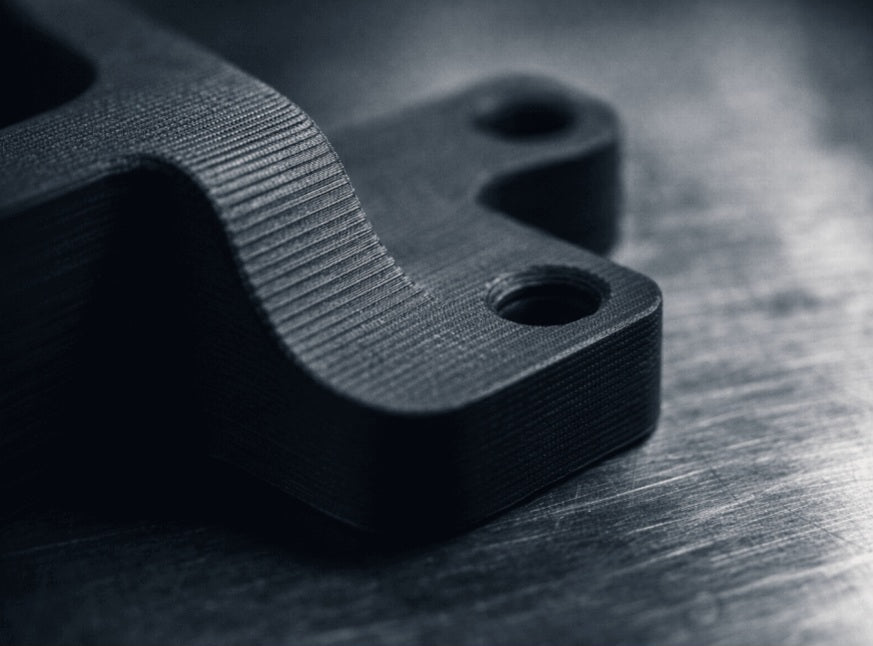
Unlocking Maximum Rigidity: When and How to Use Carbon Fiber-Reinforced Filament in Industrial 3D Printing
Stepping beyond standard baseline polymers into carbon fiber-reinforced filaments opens up an entirely new tier of structural performance for additive manufacturing. When your workshop builds heavy-duty brackets, high-load robotic end-effectors, or lightweight drone chassis that demand extreme stiffness-to-weight ratios, standard unreinforced plastics will flex, creep, and deform under stress. Incorporating short-strand chopped carbon fiber into matrices like PETG, nylon, or polycarbonate completely alters the mechanical profile, transforming flexible polymers into rigid, dimensionally stable engineering components.
Micro-Structure and Matrix Dynamics of Carbon Fiber Composites
Fiber-Matrix Bonding:
The mechanical efficacy of a carbon fiber filament relies entirely on how well the polymer matrix grips the embedded microscopic strands. High-grade industrial filaments ensure uniform dispersion and strong interfacial adhesion so that loads transfer efficiently across the fibers rather than tearing at the layer boundaries.
Thermal Stability and Low Shrinkage:
Adding carbon fibers dramatically reduces the coefficient of thermal expansion (CTE). This reduction curbs warping during printing, allowing large industrial enclosures and flat baseplates to cool evenly without pulling away from the build plate.
Abrasive Wear and Nozzle Requirements:
Chopped carbon fibers are fiercely abrasive against brass and standard steel nozzles. Running these composites requires hardening your hardware setup, switching immediately to hardened steel, tungsten carbide, or ruby-tipped nozzles paired with hardened drive gears to prevent rapid wear.
Ideal Industrial Use Cases for Carbon Fiber Filaments
High-Load Structural Brackets and Mounts:
When replacing heavy metal brackets with 3D printed alternatives, carbon fiber-reinforced nylon (PA-CF) or CF-PETG provides the flexural modulus necessary to bear heavy static and dynamic loads without sagging.
Automotive Fixtures and Jig Assemblies:
Production lines require custom jigs, alignment tools, and assembly fixtures that resist wear under repetitive mechanical cycling. CF-blended polymers offer the dimensional precision required for tight-tolerance tooling.
Lightweight Drone and Robotics Components:
Reducing rotational and inertial mass is critical in high-speed robotics. Carbon fiber filaments deliver maximum rigidity while shaving off valuable grams compared to solid unreinforced alternatives.
Critical Mechanical Metrics for Composite Selection
Flexural Modulus:
Measures the material's resistance to bending under load; carbon fiber reinforcement drastically spikes this metric, creating parts that remain dead-straight under heavy tension.
Tensile Strength:
Quantifies the maximum pulling force the composite structure can endure before fracturing along the principal stress axis.
Izod Impact Strength:
Assesses how well the brittle nature introduced by stiff carbon fibers handles sudden shock loads compared to base ductile polymers.
Balancing these mechanical gains against material input costs in ZAR ensures your workshop deploys carbon fiber filaments only where their unique structural advantages truly justify the investment. By understanding when to leverage rigid composite matrices over standard thermoplastics, you can manufacture high-performance, lightweight end-use parts that rival traditional machined aluminum or injection-molded components.


