
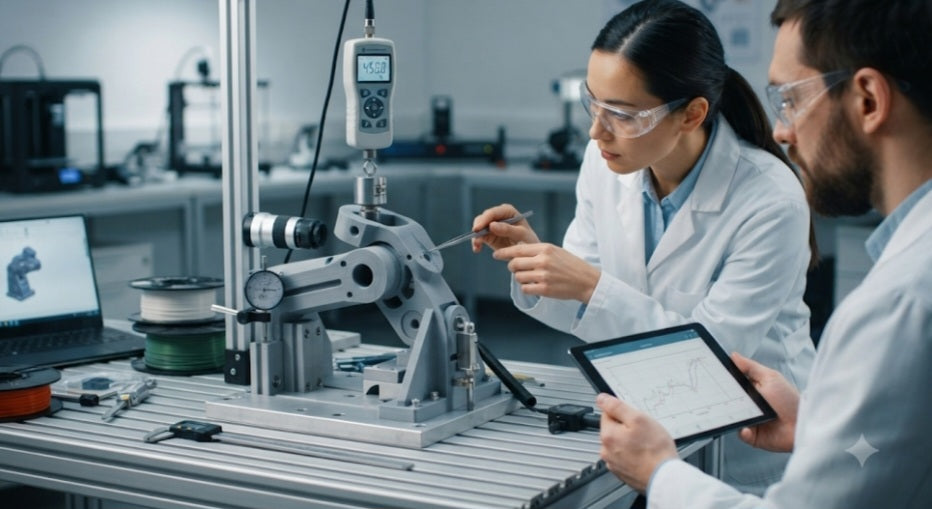
Utilizing Rapid Additive Prototyping for Comprehensive Functional Product Testing: Validating Mechanical Integrity and Ergonomics Before Tooling
Executing rigorous functional testing during the initial development phase is essential for identifying structural flaws, mechanical interference, and ergonomic deficiencies before committing capital to permanent production tooling. While traditional prototyping methods often introduce significant lead times and exorbitant custom machining expenses, leveraging high-performance 3D printing allows engineers to fabricate and test iterative geometry within hours. This rapid fabrication capability ensures that form, fit, and function can be validated under real-world operating conditions, minimizing the risk of costly post-tooling engineering changes.
Core Objectives of Additive Product Testing
Mechanical Stress and Load Verification:
Subjecting functional prints made from engineering thermoplastics or continuous fiber reinforcements to physical stress testing to evaluate ultimate tensile strength, impact resistance, and load-bearing capacity.
Ergonomic and Assembly Analysis:
Assessing human-machine interfaces, tactile feedback, snap-fit deflections, and hardware clearance through direct physical handling and mechanical assembly trials.
Iterative Design Agility:
Implementing immediate CAD modifications and reprinting updated iterations overnight to address performance bottlenecks identified during baseline mechanical trials.
Technical Considerations for Accurate Functional Simulation
Orientation and Anisotropy Management:
Configuring print paths and build orientations to ensure that directional strength vectors align with anticipated operational stress profiles.
Dimensional Accuracy and Tolerancing:
Utilizing high-precision industrial systems to verify that mating components, bearing fits, and fastener tolerances meet strict engineering specifications.
Environmental Exposure Simulation:
Testing prototype parts against thermal fluctuations, moisture exposure, and chemical agents to establish baseline material longevity.
Integrating functional additive prototyping into the development workflow bridges the gap between digital simulation and physical reality. By identifying structural weaknesses early, workshops can optimize their designs for downstream manufacturing, ensuring that final components achieve peak durability and commercial success. Furthermore, establishing a strict documentation protocol during testing—such as recording failure loads, deflection measurements, and wear patterns—provides invaluable empirical data for the final design-for-manufacture (DfM) review.


