
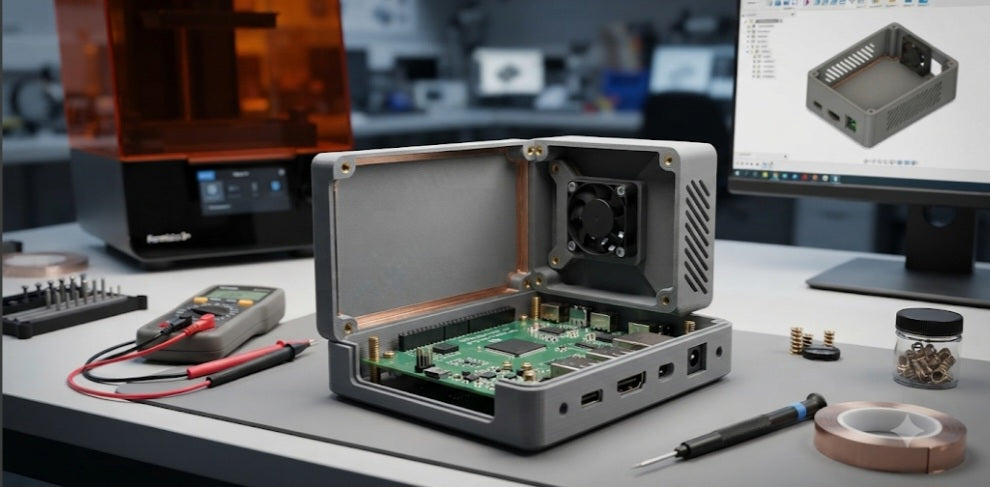
Engineering Robust 3D Printed Enclosures for Electronic Hardware: Optimizing Thermal Management, EMI Shielding, and Mechanical Fit Before Production
Thermal Management and Airflow Dynamics
Convective Venting and Ducting:
Designing integrated airflow channels, angled louvers, and dedicated fan mounts into the CAD model to prevent heat entrapment and maintain optimal operating temperatures for high-draw microcontrollers and power supplies.
Heat Dissipation via Material Selection:
Evaluating conductive filaments or integrating metal inserts to pull thermal energy away from sensitive surface-mount components without compromising structural rigidity.
Electromagnetic Interference and Environmental Sealing
EMI/RFI Shielding Strategies:
Applying conductive coatings or copper tape linings to internal walls to isolate sensitive circuits from external electromagnetic noise and prevent signal leakage.
Ingress Protection (IP) Gasketing:
Integrating compression channels and flexible TPU O-ring grooves directly into the enclosure split-lines to safeguard internal electronics against dust and moisture ingress.
Mechanical Integration and Fastener Tolerancing
Threaded Brass Insert Integration:
Utilizing ultrasonic or heat-set brass threaded inserts to guarantee robust, repetitive screw retention without stripping the surrounding polymer housing.
Snap-Fit and Cable Management Relief:
Engineering compliant cantilever snap-fits for toolless assembly alongside built-in strain relief posts and wire management channels to secure internal wiring harnesses.
Advanced Post-Processing for Functional Durability
Chemical Smoothing and Vapor Polishing:
Applying controlled vapor smoothing techniques to polymer surfaces to seal micro-pores, significantly enhancing moisture resistance and achieving a professional, factory-grade exterior finish.
Surface Hardness and UV Stabilization:
Implementing specialized post-cure coatings or selecting industrial-grade engineering filaments with built-in UV inhibitors to prevent structural degradation and yellowing when enclosures are deployed in harsh field environments.
Design-for-Manufacture (DfM) Validation and Stress Testing
Drop Impact and Structural Integrity Trials:
Subjecting fully populated prototype enclosures to rigorous physical drop tests to evaluate wall thickness resilience, corner impact absorption, and PCB mounting post-stability under shock loads.
Assembly Line Ergonomic Verification:
Assessing the efficiency of the assembly workflow by testing how easily technicians can drop in PCBs, route wiring harnesses, and secure top-shell fasteners without inducing component stress.
Integrating these pre-production validation steps into your additive manufacturing workflow creates a seamless bridge from initial digital concepts to reliable, market-ready electronic hardware. Documenting every iteration of thermal performance, drop-test resilience, and assembly feedback ensures your final engineering files are fully optimized before committing to high-volume manufacturing.


