
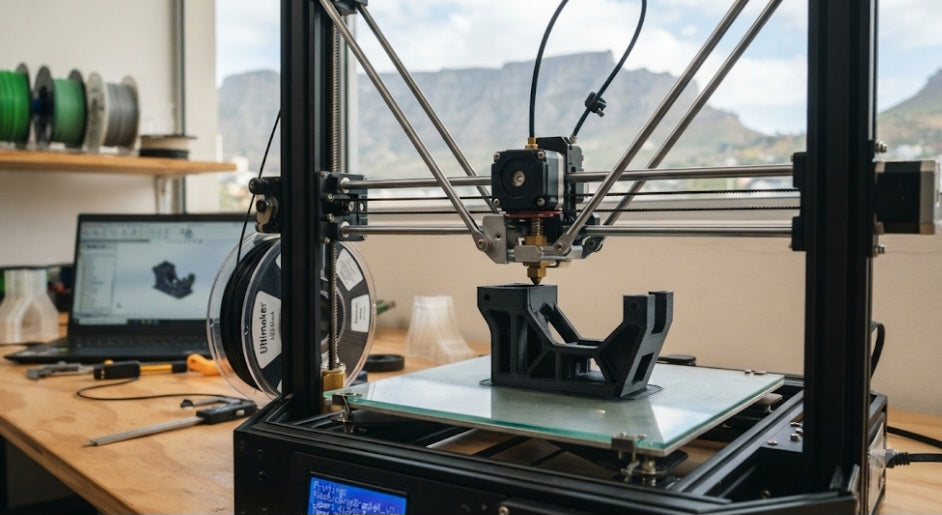
From Digital File to Physical Reality: Why On-Demand 3D Printing is Transforming One-Off Parts in South Africa
The traditional manufacturing landscape across South Africa is shifting. For decades, if you needed a custom bracket, a replacement gear for an industrial line, or a specialized prototype, you faced a frustrating roadblock: minimum order quantities, exorbitant tooling costs, and weeks of waiting for machined or injection-molded components.
Today, additive manufacturing has completely rewritten that rulebook. Whether you are an engineer operating out of a workshop in Johannesburg, an agricultural entrepreneur on the Garden Route, or a DIY inventor sketching ideas at your kitchen table, one-off 3D printing has become the ultimate equalizer for custom creation.
The Death of the Minimum Order Quantity
In standard industrial manufacturing, setting up a machine or cutting a steel mold costs a fortune. Factories need to produce thousands of identical units to amortize those setup fees. But what happens when you only need one?
This is where custom 3D printing shines. Because additive manufacturing builds objects layer by layer directly from a digital CAD file (like an STL or STEP format), there is zero tooling required. Printing a single, highly customized component costs practically the same proportional rate as printing a batch of fifty. This agility allows creators to iterate freely, test mechanical fits, and deploy unique solutions without taking financial risks.
Engineered for the Real World: Beyond Novelty Prints
There was a time when desktop 3D printing was mostly associated with plastic trinkets and cosmetic figurines. Modern industrial filaments and professional-grade printers have changed that narrative entirely. South African makers and service bureaus now utilize high-performance engineering polymers tailored for harsh environments:
ABS and ASA:
Exceptional UV stability and impact resistance, perfect for outdoor enclosures and automotive fixes.
Carbon-Fiber Reinforced Nylon:
Incredible rigidity and tensile strength, frequently used for heavy-duty structural brackets, industrial jigs, and mechanical gears.
TPU (Thermoplastic Polyurethane):
Flexible and resilient, ideal for custom vibration dampers, seals, and gaskets.
Solving South Africa’s Supply Chain Hurdles
Importing specialized replacement parts from overseas often means dealing with steep shipping fees, customs delays, and weeks of operational downtime. Localized 3D printing offers a powerful workaround. If an older machine component breaks or a discontinued bracket snaps, reverse engineering the broken piece into a digital model lets local service providers print a working replacement and ship it via courier within days.
How to Get Your One-Off Part Printed Locally
Getting a custom piece manufactured is remarkably straightforward:
The Design:
Bring a completed 3D CAD model, a rough hand sketch, or even the broken fragments of your original part. Many local shops offer design and reverse-engineering assistance.
The Material Selection:
Consult with your provider to choose a polymer that matches your mechanical, thermal, or aesthetic needs.
The Print:
The file is optimized for orientation, wall thickness, and structural infill to ensure it handles real-world loads, then sent straight to the print bed.
The barrier between a digital idea and a functional, physical component has never been lower. Whether you are solving a complex engineering challenge or bringing a brand-new product to life, on-demand custom printing ensures you are never stuck waiting on traditional manufacturing constraints again.


