
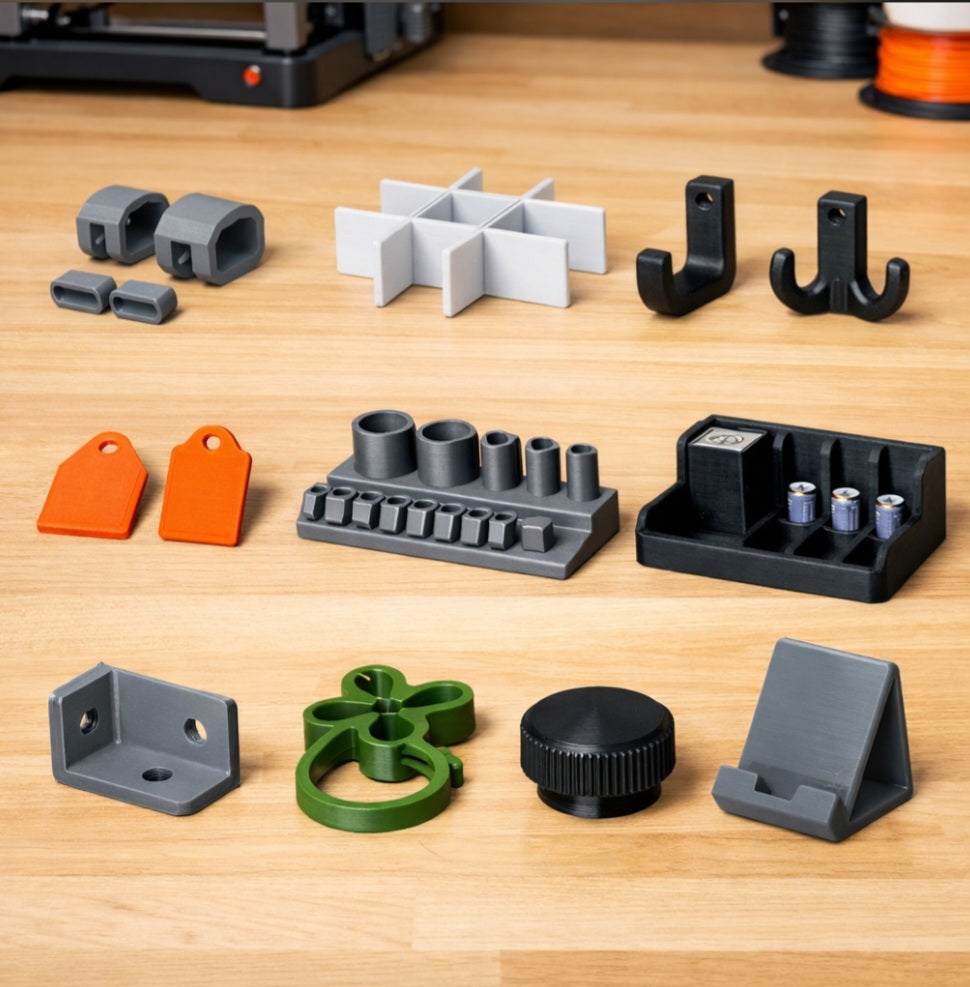
Small Parts, Massive Hassles: How 3D Printing Small Clips and Brackets Saves Broken Appliances and Household Gear
Every home contains dozens of tiny, unassuming plastic components that hold our daily lives together. From the fragile retaining clip holding a refrigerator shelf in place and the mounting bracket on a wall-mounted towel rack to the locking tab on a vacuum cleaner hose and the hinge clip on a car’s sun visor, these micro-components are essential. Yet, when one of these microscopic pieces snaps under minor stress, it triggers an infuriating chain reaction: the entire appliance, fixture, or enclosure becomes suddenly loose, dysfunctional, or completely unusable.
Historically, finding a replacement for a two-cent plastic clip was an exercise in frustration. Manufacturers rarely sell individual fasteners separately, forcing consumers into buying entire replacement assemblies or discarding functional equipment altogether over a broken piece of molded plastic.
Today, desktop 3D printing has completely upended this dynamic. Fabricating small structural clips and mounting brackets on a home printer is one of the most practical, high-value applications of additive manufacturing. But printing tiny, high-stress parts requires a different strategy than printing large figurines or decorative items. Small components demand extreme dimensional fidelity, clever orientation choices to respect layer adhesion anisotropy, and specific polymer choices that can withstand frequent bending and snapping loads.
The Engineering Strategy for Durable Clips and Brackets
Mastering the fabrication of small fasteners and brackets requires focusing on a few distinct mechanical principles:
Accounting for Snap-Fit Deflection and Elasticity:
Clips rely entirely on the ability of a material to bend without snapping permanently. Brittle materials like basic PLA will sheer the moment you try to flex a snap-fit arm into place; switching to flexible, impact-resistant polymers like PETG or tough engineering-grade TPU allows your clips to flex and latch repeatedly without degrading.
Mastering Print Orientation for Layer Strength:
3D prints are inherently weakest along their Z-axis layers. If you print a U-shaped bracket standing upright, the layer lines will run right across the stress point where the arms meet, causing it to snap instantly under load. Always lay small clips flat on the print bed so that continuous extrusion lines absorb the mechanical tension.
Optimizing Shells Over Infill:
For parts this small, sparse infill does very little to provide structural integrity. Instead of cranking up your infill percentage, increase your perimeter wall count to 4 or 5 walls. Solid or near-solid perimeters give small brackets the sheer strength needed to bear heavy loads and screw-tightening pressures.
Designing for Clearance and Tolerances:
Because plastic shrinks slightly as it cools and layer lines can create micro-roughness, designing or printing holes and slots slightly oversized (by roughly 0.1 to 0.2 millimeters) ensures that screws slide smoothly and mating components snap together without requiring aggressive post-processing file work.
The Shift Toward Localized Repair:
Mastering the production of small structural clips and brackets fundamentally changes how we maintain our physical environments, turning minor hardware failures into quick workshop solutions that eliminate waste and bypass obsolete supply chains entirely.


