
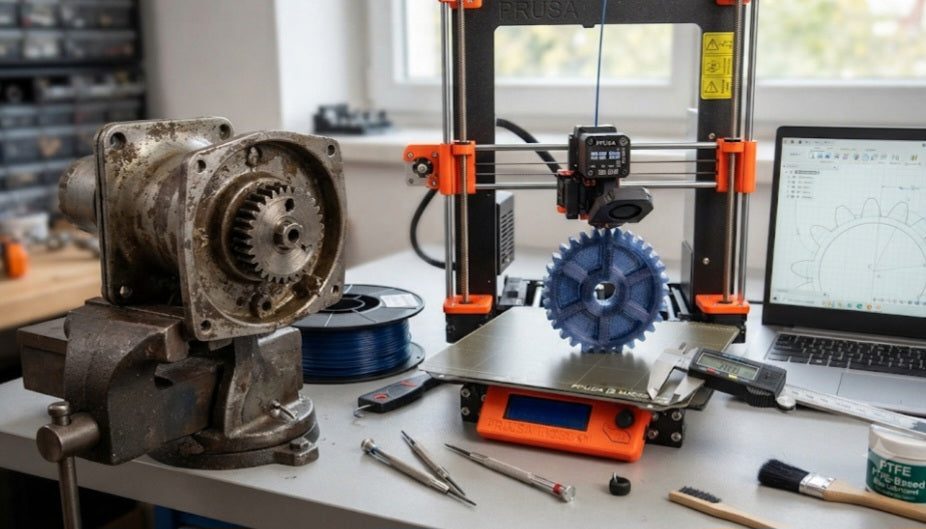
From Stripped to Swiftly Spinning: How to 3D Print High-Strength Replacement Gears That Outlast the Original Factory Parts
Every mechanical device—from vintage household kitchen appliances and motorized power tools to children's robotic toys and automotive actuators—eventually faces the same inevitable mechanical failure: a stripped or shattered gear. Because gears bear the brunt of mechanical stress, friction, and torque, they are classic wear-and-tear items. Traditionally, discovering a single missing or sheared tooth meant your entire appliance was rendered useless, doomed to be discarded because the manufacturer stopped producing spare components decades ago.
Fortunately, desktop additive manufacturing has completely transformed mechanical repair, turning what used to be a permanent hardware loss into an afternoon project. However, successfully 3D printing a functional replacement gear is vastly different from printing a decorative figurine. Gears require absolute dimensional accuracy, precise tooth profiles, and materials capable of handling intense continuous friction without melting, deforming, or stripping under load.
The Engineering Anatomy of Printing Functional Gears
Mastering gear fabrication on your desktop printer requires a careful blend of digital design optimization and material selection:
Understanding Involute Profiles and Tolerances:
A gear's teeth cannot simply be eyeballed or modeled as rough shapes; they rely on precise involute curves to ensure smooth power transmission without binding or backlash. When designing or sourcing your CAD model, accounting for printer clearance and elephant's foot on the first layer is critical to prevent teeth from locking up.
Choosing the Right High-Performance Polymer:
Standard brittle filaments like basic PLA will snap under pressure. For durable gears, upgrade to tough engineering polymers like Nylon for low-friction self-lubricating properties, carbon-fiber reinforced PETG for enhanced rigidity, or durable ABS/ASA for sustained mechanical loads.
Optimizing Slicing Parameters for Strength:
Wall count and infill strategies matter immensely when printing rotating components. Instead of using sparse grid infill, configure your slicer for concentric walls or 100% solid infill patterns to ensure the gear teeth bear mechanical loads evenly across every rotation.
Post-Processing and Mechanical Break-In:
Even well-tuned prints can benefit from a little mechanical smoothing. Lightly filing away minor stringing or using specialized lubricants ensures that your newly printed gear meshes seamlessly with existing metal or plastic counterparts right out of the gate.
The Future of Self-Healing and Composite Gear Systems:
Beyond traditional solid polymer prints, cutting-edge research in additive manufacturing is paving the way for multi-material functional gears embedded with micro-channels for liquid lubricants or reinforced with continuous carbon-fiber strands. These advanced techniques dramatically reduce wear rates and friction coefficients, allowing 3D printed gears to match or even surpass the lifespan of traditional injection-molded industrial components.


