
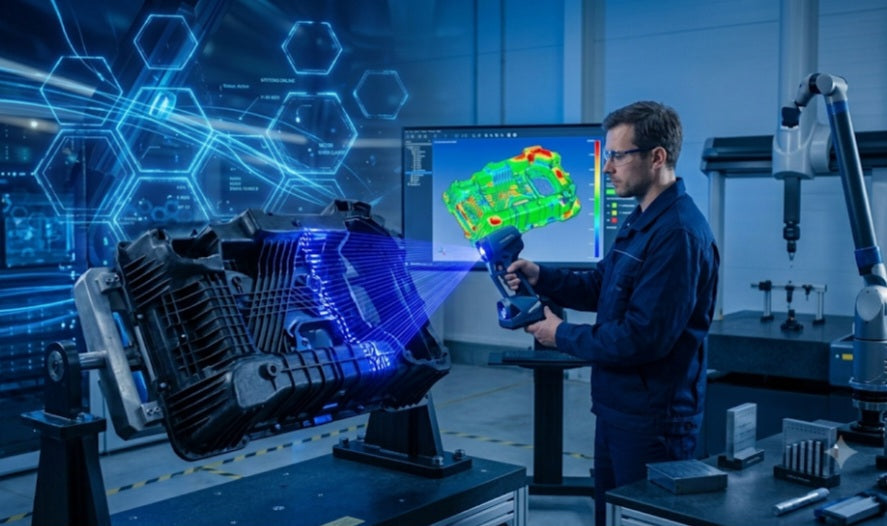
Precision from Prototype to Production
Injection moulding is the backbone of mass production, but even small errors in mould design or part geometry can lead to massive losses when multiplied across thousands of units.
3D scanning provides the high-fidelity data necessary to refine the entire injection moulding lifecycle, ensuring that the transition from a digital concept to a physical product is flawless.
Validating First-Article Samples
The "First Article" is the most critical stage in injection moulding. Once the mould is injected for the first time, 3D scanning is used to verify that the resulting part meets all tolerance requirements.
Dimensional Accuracy:
Scanning compares the physical sample against the CAD file to confirm that all wall thicknesses, radii, and features are within specification.
Flash and Sink Mark Detection:
The high-resolution data captures even minor surface defects, such as flash at the parting line or sink marks caused by uneven cooling, allowing for immediate adjustments to injection parameters or mould venting.
In-Line Quality Control
In high-volume environments, quality can drift due to variations in material batching, temperature fluctuations, or mould wear. Implementing 3D scanning as an in-line or near-line quality check allows for continuous monitoring.
By scanning parts at set intervals, manufacturers can detect early signs of process instability—such as a slight increase in part weight or a shift in dimensions—enabling proactive machine adjustments that keep the production run within the "green zone" of acceptable quality.
Bridging the Gap: The "As-Built" Mould
Over the lifetime of an injection mould, it may undergo multiple repairs, re-polishing, or engineering change orders. Eventually, the physical mould may differ from its original digital design.
3D scanning the "as-built" mould allows for an updated digital twin. This record is vital for future troubleshooting, ensuring that if a part defect appears later, engineers can check the current state of the mould cavity against the actual produced geometry to pinpoint the exact location of the issue.
Optimizing Part Weight and Material Use
For high-volume producers, saving even a fraction of a gram per part can translate to significant cost savings in raw material over a year.
3D scanning allows engineers to perform "wall thickness analysis" on the produced parts.
By identifying areas where the part is thicker than necessary, designers can modify the mould to optimize material distribution, reducing cycle times and lowering the cost per unit without sacrificing the part's structural integrity.
Simulating Cooling and Filling Dynamics
Advanced injection moulding processes rely on complex thermal and fluid simulations to predict how plastic will flow into the cavity.
However, these simulations are only as accurate as the input data. 3D scanning provides the "real-world" geometry of the mould and its internal cooling channels, which can be fed back into simulation software to validate or refine the digital models.
By comparing the simulated flow paths with the actual physical outcome of the moulded parts, engineers can calibrate their software to be far more predictive.
This creates a powerful iterative loop where virtual simulations and physical scanning data continuously improve one another, leading to faster mould development cycles and more predictable production outcomes.


