
Achieving Consistency at Scale
Moving from the prototype phase into full-scale production introduces a new set of challenges where speed, repeatability, and cost-efficiency are paramount.
3D scanning has evolved beyond a lab-based metrology tool to become a vital component on the production floor, helping manufacturers maintain tight tolerances across thousands of units.
Automated In-Line Inspection
In high-volume production, manual inspection cannot keep up with the speed of manufacturing equipment.
Rapid Throughput:
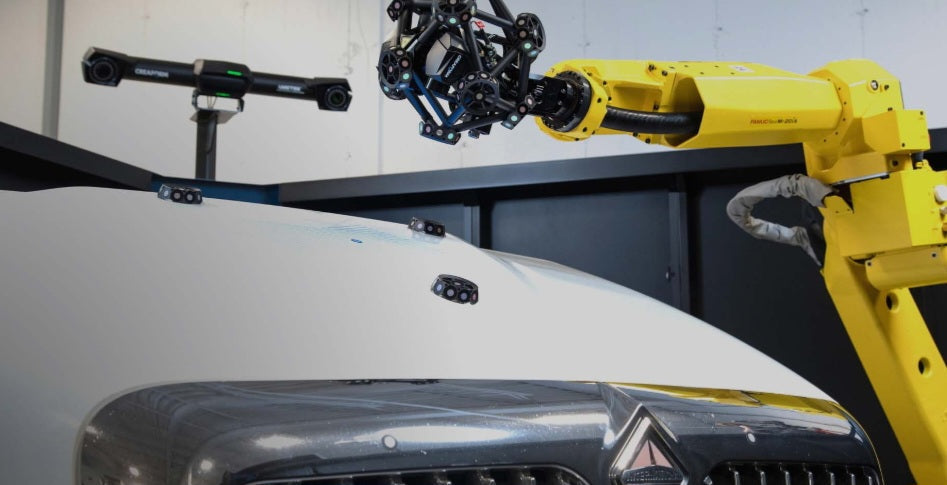
Integrated 3D scanning systems, often mounted on robotic arms, can inspect parts in seconds as they exit the machining or moulding cycle.
Real-Time Feedback:
By automating the scan process, production teams receive instant, actionable data that can trigger machine adjustments automatically, preventing the production of large batches of out-of-tolerance scrap.
Monitoring Tool and Fixture Wear
Production tools and fixtures are subject to constant stress, leading to gradual degradation that can compromise part quality over time.
Proactive Maintenance:
Frequent 3D scanning of tooling allows operators to track the exact rate of wear or thermal drift, shifting the maintenance strategy from reactive to predictive.
Fixture Validation:
Ensuring that clamping fixtures remain perfectly aligned is critical for assembly quality; scanning verifies these fixtures at set intervals to confirm they have not shifted due to vibration or repetitive loading.
Digital Twin Integration
The concept of the "Digital Twin" is most powerful when it reflects the current state of the production process.
Historical Performance Tracking:
Storing scan data for every production run creates a comprehensive digital archive that maps part quality to specific machine parameters, time stamps, and material batches.
Root Cause Analysis:
If a failure occurs, engineers can review the digital history of the tooling and the part’s evolution, drastically reducing the time required to diagnose production bottlenecks or quality issues.
Optimizing Process Flow and Throughput
Beyond direct quality checks, 3D scanning plays a crucial role in eliminating production bottlenecks caused by alignment issues or assembly errors.
By scanning components before they enter a multi-stage assembly line, manufacturers can ensure that parts are properly oriented and free of deformations that would otherwise cause machinery to jam or manual assembly steps to fail.
This preemptive validation ensures that the production line maintains high uptime and steady throughput, as it eliminates the "surprise" downtime that often occurs when flawed components are introduced into downstream processes.


