
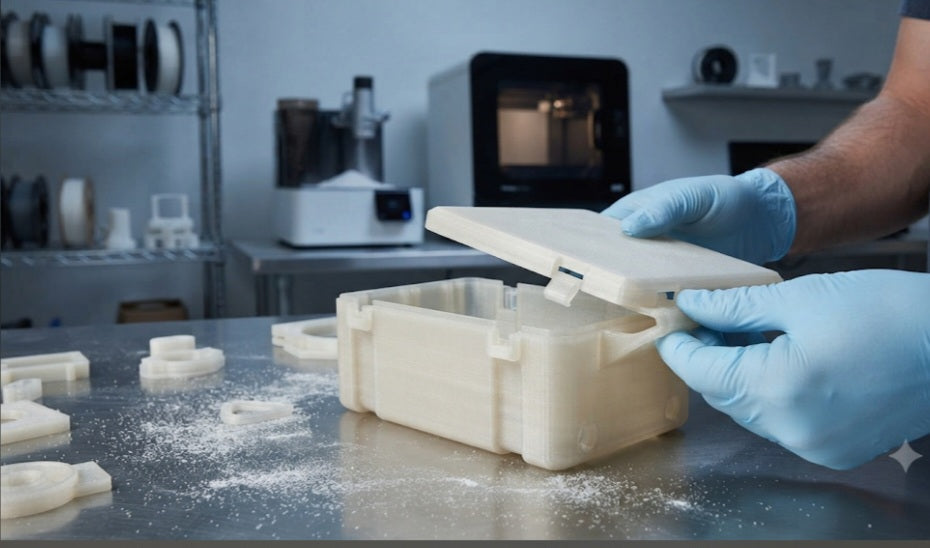
Designing for Deflection: the Best 3D Printing Filament for Durable Snap-Fit Joints
Creating reliable snap-fit assemblies using additive manufacturing requires balancing extreme flexibility with structural resilience. When your workshop builds functional enclosures, battery covers, or modular clips that must flex without snapping, choosing the wrong rigid material leads to immediate fatigue failure and broken tabs. Mastering the mechanics of cantilever snaps means picking polymers that can withstand repeated cyclic deflection while maintaining high elastic memory.
Top Engineering Filaments for High-Performance Snap-Fit Joints
PETG (Polyethylene Terephthalate Glycol):
A brilliant baseline choice for everyday snap-fits, offering a fantastic blend of layer adhesion, chemical resistance, and moderate flexibility that allows cantilever tabs to deflect cleanly.
TPU / TPE (Thermoplastic Polyurethane):
For joints requiring extreme deflection angles or living hinges that must bend thousands of times, flexible polyurethane delivers unmatched elongation at break and a remarkably secure, rubberized snap action.
Polypropylene (PP):
Widely celebrated in industrial injection molding for living hinges, PP brings supreme fatigue resistance and low friction to custom 3D printed enclosures, though it demands specialized adhesive sheets.
Unfilled or Low-Additive Polyamide (Nylon):
Pure industrial nylons possess natural self-lubricating properties and high impact strength, allowing snap-fit cantilever arms to bend smoothly and lock into place with exceptional long-term durability.
Critical Mechanical Metrics for Snap-Fit Integrity
Elongation at Break:
Quantifies how much a material can stretch before snapping, dictating how far a cantilever beam can deflect during assembly.
Flexural Modulus:
Measures the stiffness of the polymer; lower moduli make bending easier, while higher moduli provide a tighter, more rigid latching force.
Izod Impact Strength:
Determines how well the joint absorbs sudden shock loads when parts are snapped together or forced apart rapidly.
Balancing these mechanical properties against material input costs in ZAR ensures your workshop delivers dependable, long-lasting snap-fit enclosures. By selecting polymers engineered for high elastic recovery and superior impact resistance, you can manufacture robust, tool-less assemblies that rival injection-molded production standards.


