
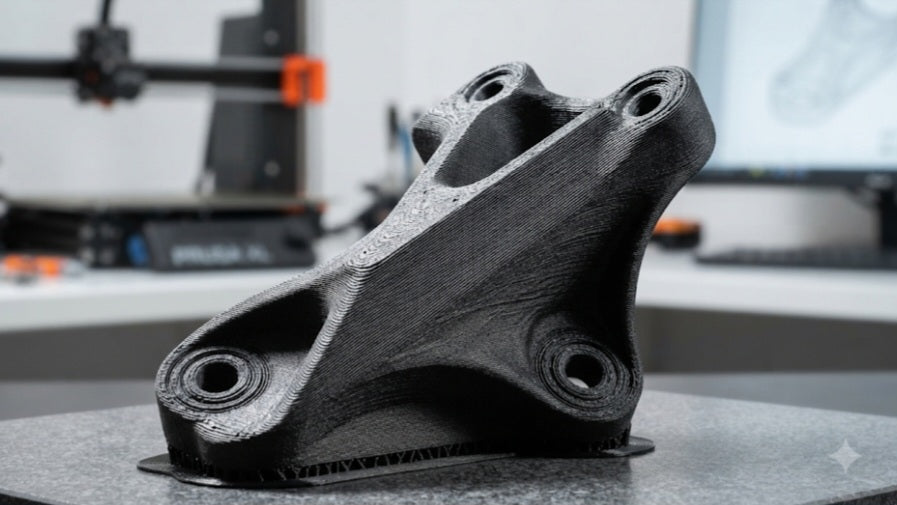
Mastering Anisotropic Mechanics: How Strategic Print Orientation Determines the Ultimate Yield Strength of Functional 3D Printed Parts
When manufacturing high-load mechanical components through fused deposition modeling, choosing the correct CAD geometry is only half the battle. Because 3D printed objects are built layer by layer, they exhibit inherently anisotropic mechanical properties—meaning their structural performance changes dramatically depending on the axis of applied force. While hobbyists often orient models purely for aesthetic finish or to minimize support material, industrial engineers know that print orientation is the single most critical factor in preventing catastrophic inter-layer delamination under operational loads.
Understanding the Anisotropic Nature of Fused Deposition Modeling
Z-Axis Vulnerability:
The microscopic bond holding stacked polymer layers together along the vertical Z-axis is always significantly weaker than the continuous, unbroken extrusion lines running horizontally across the XY plane.
Shear vs. Tensile Stress Vectors:
When tensile or bending loads pull perpendicular to the layer lines, the part relies entirely on the thermal fusion of adjacent passes. Under heavy shear stress, these interfaces become fracture planes where premature cleavage occurs long before the base polymer reaches its ultimate tensile strength.
Vector Alignment:
Designing and orienting components so that principal stress vectors run parallel to continuous extrusion paths ensures the raw polymer backbone absorbs the load instead of forcing layer-to-layer adhesion to resist the force.
Strategic Orientation Rules for Strategic Orientation Rules for Industrial Load-Bearing Parts Load-Bearing Parts
The Cantilever Rule:
Never print cantilevered pins, hooks, or mounting tabs flat along the Z-axis if they will experience downward bending loads. Tilting or rotating the geometry ensures the continuous perimeters wrap through the high-stress radius.
Pin and Fastener Holes:
Orienting cylindrical holes horizontally on the bed creates an ovaling artifact that requires clean-up, but printing them vertically creates a weak Z-axis ring susceptible to splitting under bolt-tightening torque. Strategic reinforcement or re-orienting split-body assemblies solves this compromise.
Utilizing Shear-Resistant Angles:
Rotating complex brackets at a 45-degree angle can sometimes distribute shear forces across multiple axes, preventing localized stress concentrations from ripping straight across a single horizontal layer plane.
Mastering print orientation transforms an ordinary prototype into a resilient, deployment-ready mechanical component. By aligning your build plates around the physics of anisotropic stress rather than convenience, your workshop can eliminate structural weak points and guarantee long-term reliability in demanding environments.
To bridge the gap between theoretical CAD modeling and real-world shop floor execution, advanced additive manufacturing facilities also utilize sacrificial anchor gussets and internal fillet optimization. Integrating localized geometric thickening directly into high-stress pivot points distributes clamping and operational forces across a wider surface area, effectively neutralizing the inherent mechanical limitations of layer-by-layer polymer deposition.


