
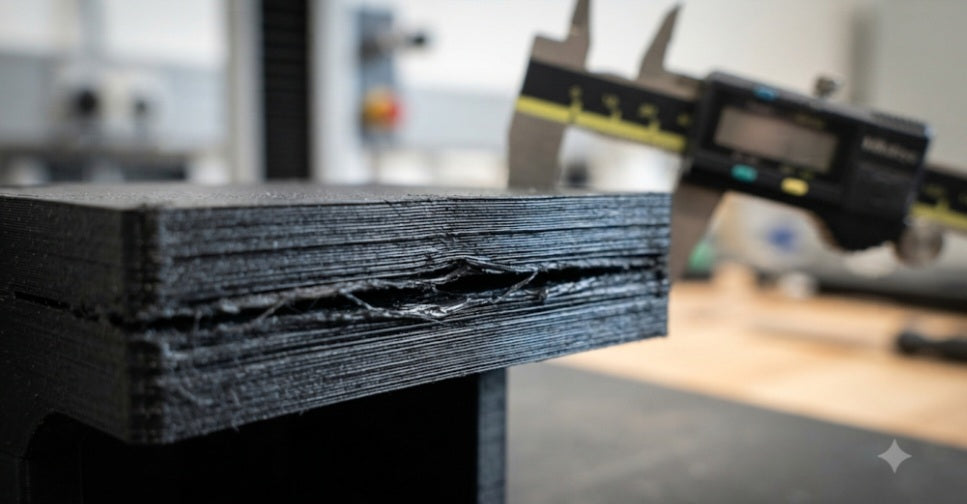
Deconstructing Anisotropic Failure: How Layer Direction Dictates the Ultimate Mechanical Strength of 3D Printed Parts
When manufacturing functional end-use components via fused deposition modeling, treating a CAD model as an isotropic block—similar to injection-molded or machined metal stock—is a critical engineering mistake. Because 3D printed objects are built through the sequential thermal deposition of stacked polymer strands, they possess inherently directional, or anisotropic, mechanical profiles. While tensile strength along the horizontal XY plane is typically governed by the raw polymer's molecular backbone, structural resistance along the vertical Z-axis depends entirely on thermal layer-to-layer fusion. For professional workshops and industrial fabricators, understanding how layer direction dictates mechanical performance is essential for eliminating catastrophic structural failures.
The Physics of Inter-Layer Adhesion and Stress Vectors
Thermal Fusion Mechanics:
As an extrusion nozzle lays down molten thermoplastic, it must thermally bond with the previously deposited layer below. If the thermal energy dissipates too quickly, complete molecular entanglement fails to occur, leaving microscopic boundary weak points.
Tensile vs. Shear Disparities:
When loads are applied parallel to the XY plane, continuous perimeter vectors absorb the energy. Conversely, when tensile or bending stresses pull perpendicular to the layer lines, the component relies entirely on inter-layer adhesion, drastically lowering its yield threshold.
Cleavage Planes Under Load:
Under high shear stress, horizontal layer lines act as pre-existing micro-notches. Torsional twisting or cantilevered bending forces will exploit these planes, causing clean, brittle cleavages long before the bulk plastic reaches its true material limits.
Engineering Countermeasures for Workshop Production
Vector-Aligned Design:
Design geometries so that primary load-bearing axes run parallel to continuous extrusion paths rather than forcing stacked layers to resist direct tensile pulling.
Optimizing Thermal Control:
Utilize enclosed build chambers and elevated bed temperatures to slow down cooling rates, maximizing molecular diffusion across the nozzle-to-layer interface.
Strategic Part Orientation:
When slicing complex brackets, pins, or load-bearing fixtures, always tilt or rotate the part on the build plate to prevent critical stress vectors from aligning perpendicularly with the Z-axis layers.
Mastering layer direction transforms an ordinary prototype into a reliable, load-bearing mechanical component. By designing around the anisotropic realities of additive manufacturing, your workshop can eliminate structural delamination and ensure long-term deployment success in demanding industrial environments.
To further optimize your components against anisotropic failure, implementing localized annealing workflows or selecting engineering-grade polymers with high thermal stability can significantly enhance inter-layer diffusion. Post-print heat treatment relieves internal residual stresses trapped during rapid cooling, allowing polymer chains to cross-link more thoroughly across the Z-axis interfaces and yielding a substantially tougher, more uniform mechanical structure.


