
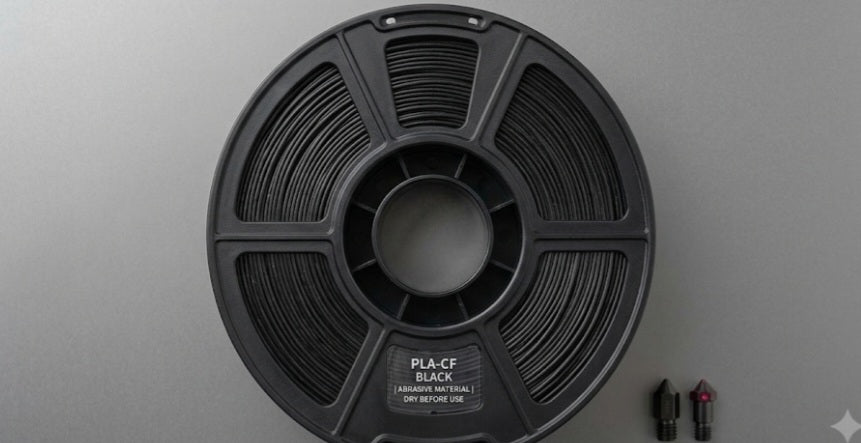
Yes, a "normal" FDM (Fused Deposition Modeling) 3D printer can print with carbon fiber filament, but with a few important adjustments.
It is helpful to understand that the "carbon fiber" you buy for home 3D printers is actually chopped carbon fiber—tiny, short strands of fiber mixed into a standard plastic like PLA, PETG, or Nylon.
Here is what you need to know to get it working on a standard machine:
- You Must Upgrade Your Nozzle
This is the most critical step. Carbon fiber is extremely abrasive and acts like sandpaper inside your hotend.
The Problem: A standard brass nozzle will be worn down very quickly, causing clogs and inconsistent extrusion.
The Solution: You must switch to a hardened steel, ruby-tipped, or tungsten nozzle. These are designed to withstand the abrasiveness of the carbon fibers.
2. Check Your Filament Base
"Carbon fiber" is just an additive, so the printer needs to be capable of printing the base material.
PLA-CF: This is very easy to print on almost any standard hobby printer; it behaves similarly to regular PLA.
Nylon-CF or ABS-CF: These are more advanced. They often require higher temperatures and an enclosure to prevent warping and ensure the parts stay strong.
3. Adjust Your Settings
Because of the added fibers, the filament behaves a bit differently than standard plastic:
Nozzle Size: A 0.4mm nozzle is the minimum, but a 0.6mm nozzle is often recommended to prevent the fibers from clogging the opening.
Speed: You should generally print slightly slower (around 30–50 mm/s) to give the material time to melt and flow properly.
Moisture: Carbon fiber-filled filaments (especially nylon-based ones) are "hygroscopic," meaning they absorb moisture from the air. Keep them in a sealed container or use a filament dryer to avoid printing issues.
A Quick Reality Check
While "carbon fiber" filament makes your prints stiffer, stronger, and more dimensionally stable, it is not the same as a professional carbon fiber composite part. It won't give you the extreme strength of "continuous fiber" industrial printing, but it is excellent for functional prototypes, RC vehicle parts, and props that need to be rigid and lightweight.


