
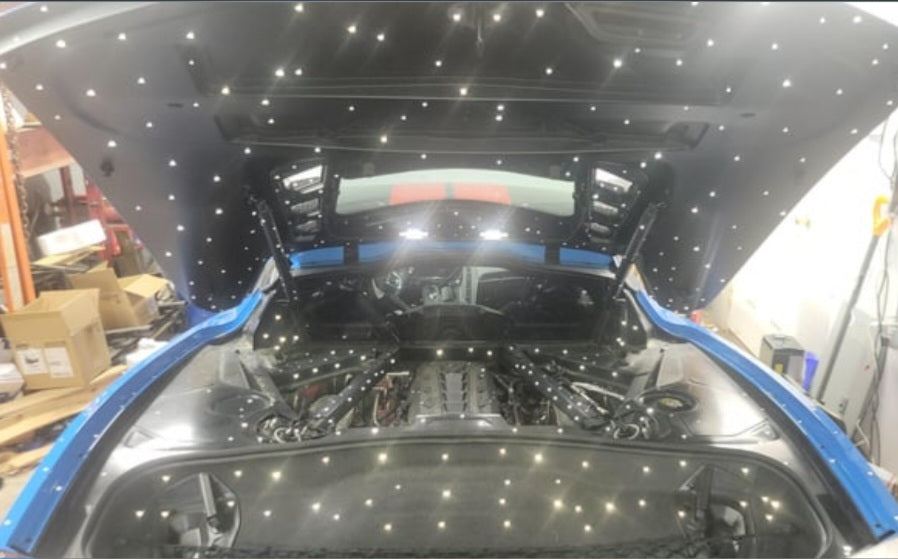
Can You Scan an Engine Bay? Master Complex Under-the-Hood Customization
When you are performing an engine swap, building a custom manifold, or retrofitting a new cooling system, you are dealing with one of the most crowded and complex spaces in a vehicle.
An engine bay is a dense environment filled with pipes, wiring, sensors, and structural components. Trying to measure these spaces with traditional tools is often impossible.
This leads to the most common question we get from performance builders: "Can you actually scan an engine bay?"
The answer is yes—and it is the ultimate shortcut for precision fabrication.
Why Engine Bays Are a Challenge
The engine bay is a "nightmare" of geometry. You are looking at:
Occlusion: Components often hide behind other components, making it difficult to get a complete line-of-sight to the chassis walls.
Heat & Materials: Various materials—ranging from polished metal to matte-black rubber—react differently to light, creating challenges for high-end optical scanners.
Heat & Materials: Various materials—ranging from polished metal to matte-black rubber—react differently to light, creating challenges for high-end optical scanners.
Dynamic Clearances: When building parts, you aren't just measuring static components; you have to account for engine movement, heat expansion, and service accessibility.
The Advantages of 3D Scanning the Engine Bay
Using high-resolution 3D scanning to digitize an engine bay transforms your fabrication process:
Custom Fabrication at Scale: Want to build a custom turbo kit or an intake plenum that fits perfectly into the existing space? Scanning provides the exact spatial map of what is available, allowing you to design components that avoid "clashes" with the chassis or other accessories.
Validation Before Fabrication: By importing a 3D scan of the engine bay into your CAD software, you can perform a virtual fitment test of your new design. You will know exactly if that custom pipe will clear the steering rack or the firewall long before you pick up a welder.
Complex Routing: Designing custom hoses, electrical looms, or fuel lines becomes much simpler when you have a 3D reference model of the entire bay layout.
Our Professional Workflow
We ensure that your digital engine bay is as accurate as the physical one:
- Strategic Access: We work with you to clear necessary components so we can capture the "inner sanctum" of the bay, including firewall features and chassis pick-up points.
2. Point Cloud Alignment: We carefully align multiple scans to create a cohesive model that maintains absolute spatial integrity.
3. CAD-Ready Data: We process the scan data into a high-fidelity model that you can use as a reference layer for all your design and engineering work.
If you are serious about precision performance fabrication, 3D scanning is the tool that puts you on par with professional motorsport teams.
It removes the stress of "measure-twice, cut-once" and replaces it with the confidence of "verify-digitally, fit-perfectly." Whether you are undertaking a ground-up build or a complex modification, scanning your engine bay is the best way to ensure your vision fits, functions, and performs.


