
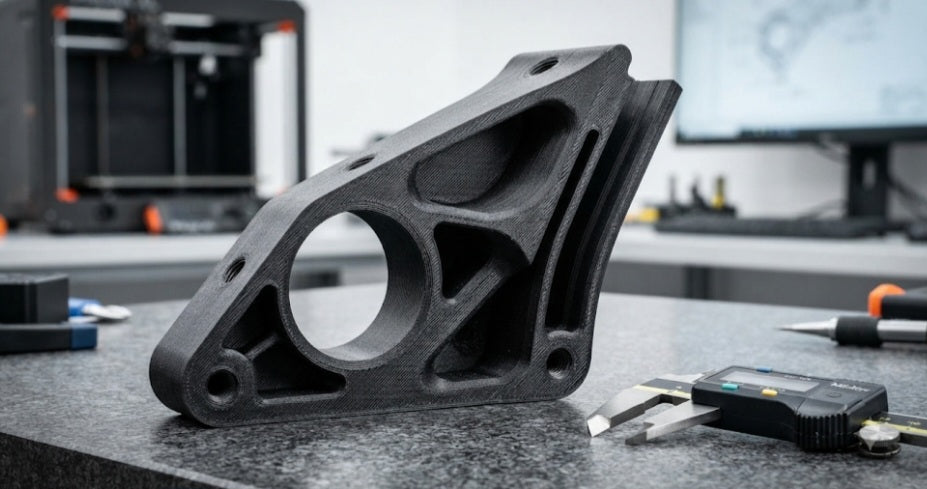
Design for Additive Manufacturing: Principles and Geometric Strategies for Functional 3D Printed Parts
When transitioning a concept from traditional subtractive machining or injection molding into the additive manufacturing workflow, designing components without accounting for the physical realities of fused deposition modeling leads to structural failure. Unlike milled metal or cast plastics, 3D printed objects are built layer by layer under intense thermal gradients, requiring engineers to completely rethink how parts handle overhangs, internal stresses, and mechanical loads. For workshop professionals and industrial designers, mastering the core tenets of Design for Additive Manufacturing (DfAM) is essential for producing reliable, functional end-use components.
Core Geometric Rules for Additive Manufacturing
Managing Overhangs and Self-Supporting Angles: Designing features that respect the 45-degree rule eliminates the need for excessive support material, reducing post-processing labor and preventing surface scarring on critical mating faces.
Eliminating Sharp Internal Corners:
Acute 90-degree internal transitions act as natural stress concentration points, causing localized cracking under load and thermal warping during cooling; replacing them with generous fillets distributes mechanical forces evenly.
Optimizing Wall Thickness to Extrusion Widths:
Designing walls as exact multiples of your nozzle's extrusion width prevents slicer gaps, voids, and weak infill-to-perimeter transition zones.
Advanced Structural Enhancements on the Shop Floor
Incorporating Split-Body Assemblies:
Breaking complex geometries into smaller, interlocking sub-components allows you to print each section in an orientation that places maximum stress along the strong XY plane rather than vulnerable Z-axis layers.
Designing for Post-Processing Tolerances:
Accounting for thermal shrinkage, anisotropic contraction, and minor material squish ensures that press-fits, captive nuts, and bearing pockets achieve precise mechanical clearances right off the build plate.
Integrating Internal Gussets and Ribbing:
Strategic placement of internal bracing increases structural rigidity and torsional resistance without adding unnecessary weight or excessive filament consumption.
Adopting a DfAM mindset transforms additive manufacturing from a rapid prototyping novelty into a robust, high-performance production method. By structuring your CAD files around the mechanics of extrusion, thermal shrinkage, and directional strength, your workshop can consistently manufacture durable, industrial-grade parts that withstand harsh operational demands.


