
Designing Precision Press-Fit Joints in 3D Printed Assemblies: Tolerances, Interference Mechanics, and Material Shrinkage
Achieving permanent or semi-permanent mechanical connections without hardware relies heavily on mastering press-fit joints, where shafts, pins, or metal inserts are locked into mating 3D printed holes through intentional dimensional interference. In traditional manufacturing, machining metals to tight micrometer tolerances guarantees predictable friction fits. However, in fused deposition modeling, achieving reliable press-fits requires navigating anisotropic material shrinkage, directional layer deformation, and the elastic-plastic deformation behavior of extruded polymers. For workshop professionals and industrial designers, understanding how to engineer these interference fits prevents loose assemblies, cracked bosses, and costly post-print rework.
Understanding Interference Fit Mechanics in Additive Manufacturing
Radial Stress and Hoop Stress:
When a slightly oversized shaft is forced into a smaller printed hole, the surrounding plastic wall experiences radial and hoop stresses; if the interference value exceeds the polymer's ultimate tensile strength, the surrounding boss will split along its vertical layer lines.
Anisotropic Hole Distortion:
Due to the physics of cooling and perimeter deposition, printed holes rarely remain perfectly circular; slight ovality caused by cooling gradients can compromise symmetrical friction grip and eccentric loading alignment.
Thermal Contraction and Slicer Flow Dynamics:
Molten plastic contracts slightly as it cools on the build plate, meaning nominal CAD dimensions often deviate from actual physical prints, requiring empirical offset compensation.
Shop Floor Strategies for Precision Press-Fits
Applying Specific Diametric Allowances:
Design interference holes with a diametric allowance typically ranging between 0.1 mm to 0.3 mm depending on the material's modulus of elasticity and your printer's specific extrusion calibration.
Reinforcing Mating Bosses:
Never design a press-fit hole in a thin, unreinforced wall; incorporate thick perimeters, solid infill regions, or exterior gussets to absorb the outward radial hoop stresses without failing.
Utilizing Chamfered Lead-Ins:
Add a 45-degree chamfer or a slight lead-in pilot on both the mating pin and the entrance of the hole to guide the components smoothly into alignment, preventing initial shear gouging during the press operation.
Mastering press-fit engineering elevates your 3D printing workflow from basic prototyping to precise mechanical manufacturing. By accounting for material behaviors and tight geometric tolerances, your workshop can create robust, friction-locked assemblies that hold securely under demanding industrial loads.
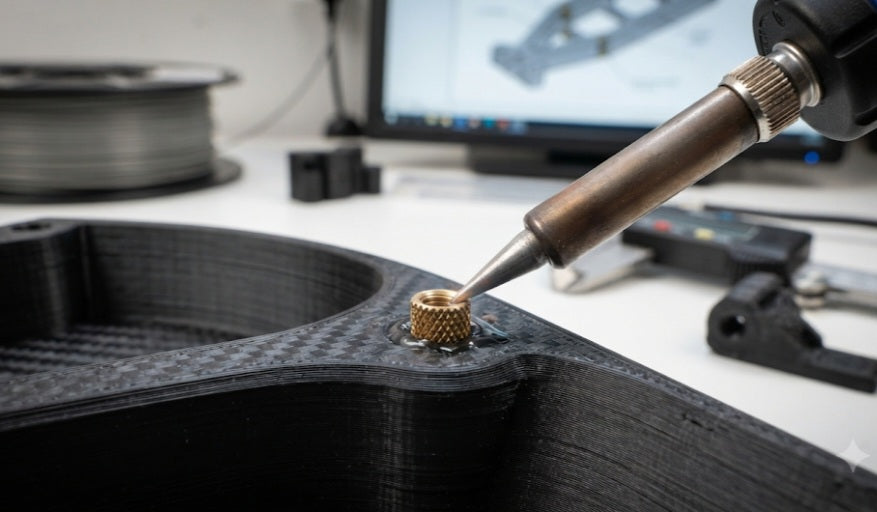
To ensure long-term reliability under continuous operational vibration, consider incorporating thermal press-fitting techniques or utilizing brass heat-set inserts alongside traditional interference fits. Applying a controlled amount of localized heat softens the immediate polymer boundary just enough to let knurled inserts seat perfectly flush before locking permanently into the matrix as the plastic cools, effectively eliminating long-term creep and stress relaxation in high-stress environments.


