
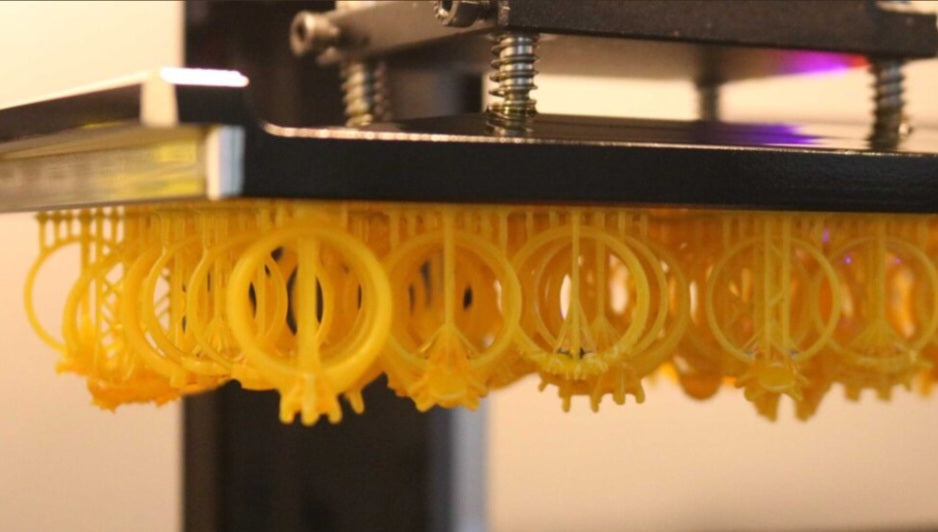
Transitioning from standard tabletop miniatures to precision jewellery manufacturing requires an entirely different tier of resin 3D printing. While hobby resins prioritize visual aesthetics and ease of painting, jewellery masters demand high-performance castable resins engineered to burn out cleanly during the lost-wax casting process. Whether you are printing intricate filigree rings, signet bands, or organic pendant settings, understanding how castable formulations react during laser or MSLA exposure is vital for goldsmiths and artisan makers. Evaluating ash content, dimensional shrinkage, and green-state flexibility ensures your printed masters translate flawlessly into precious metals like gold, silver, and platinum.
Understanding Burnout Residue:
High-quality castable resins feature specialized wax or polymer blends designed to vaporize completely at high kiln temperatures without leaving carbon ash, which causes porous casting defects.
Managing Viscosity and Flow:
Castable resins are often significantly more viscous than standard formulations, requiring calibrated exposure times and slower lift speeds to prevent layer delamination on delicate filigree.
Controlling Thermal Shrinkage:
Factoring in precise dimensional shrinkage rates during the CAD and slicing stages ensures rings maintain exact ring-size tolerances after the casting burnout cycle.
Green-State Handling:
Treating ultra-fine jewelry prints with extreme care prior to final UV curing prevents micro-distortion on razor-thin prongs and micro-prong settings.
Refining your jewellery production workflow also requires strict adherence to post-processing and curing protocols tailored specifically for investment casting. Over-curing a castable resin can cause surface cross-linking issues that trap gases inside the plaster investment mold, resulting in blowout or surface pitting when molten metal is introduced. Furthermore, utilizing specialized ultrasonic cleaning baths with high-purity isopropyl alcohol or specialized resin cleaners removes uncured residue from complex internal channels without swelling or softening the fine structural details.
Optimizing UV Post-Curing:
Limiting post-exposure times to manufacturer recommendations prevents the resin from becoming over-polymerized, which directly inhibits clean thermal burnout in the kiln.
Alcoho-Washing Precision:
Using clean solvent baths and soft-bristle brushes clears out trapped resin inside delicate gemstone settings before any light curing takes place.
Surface Smoothing Techniques:
Implementing vapor smoothing or careful manual polishing on the printed master reduces microscopic layer lines, saving hours of finishing work on the final metal casting.
Kiln Ramp-Up Profiles:
Following custom burnout temperature schedules prevents rapid thermal expansion from cracking the investment flask before the polymer fully dissipates.
Mastering castable resin testing bridges the gap between digital design and traditional artisan goldsmithing, unlocking unprecedented geometric complexity for bespoke jewelry makers. By selecting clean-burning formulations, fine-tuning your exposure and washing parameters, and dialing in precise kiln burnout profiles, you achieve flawless, professional metal casts every single time. Incorporating these rigorous testing standards elevates your custom jewelry production to gallery-grade quality.


