
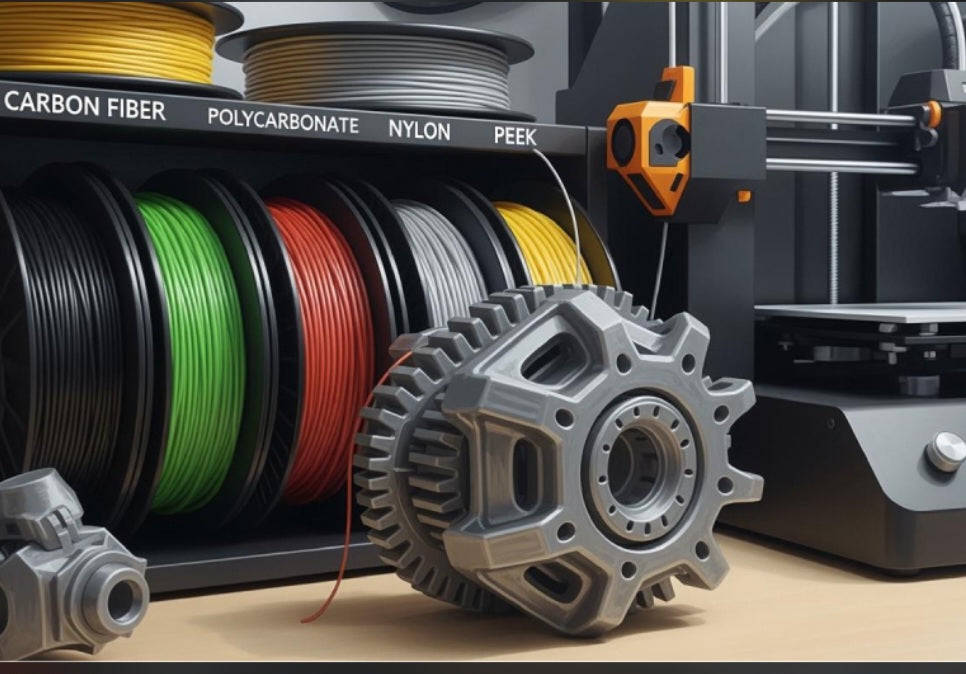
When choosing the best filament for strong parts, there is no single "best" material because the right choice depends on the type of stress, heat, and environment the part will face.
Here is a guide to the strongest options based on your specific needs:
1. The Heavyweights (Industrial/High-Stress)
For parts that must withstand extreme heat, heavy loads, or industrial environments, these are your top choices:
PEEK / PEKK: Considered the "gold standard" for strength and heat resistance (over 250°C). These are industrial-grade materials that typically require specialized, high-temperature equipment.
Polycarbonate (PC): Widely regarded as the strongest filament accessible for hobbyists and professionals alike. It has extremely high tensile strength and impact resistance, making it ideal for mechanical components and protective gear.
2. High-Performance Composites
Adding fibers (like carbon or glass) to a base material significantly improves stiffness and structural rigidity.
Carbon Fiber Reinforced Nylon (PA-CF / PPA-CF): These offer an excellent stiffness-to-weight ratio. They are less flexible than pure nylon, providing better structural performance for things like drone frames or RC parts.
Abrasive Warning: Because carbon and glass fibers are abrasive, you must use a hardened steel or ruby-tipped nozzle to print these materials.
3. Tough & Durable Options
If your part needs to handle repeated stress without shattering, consider these:
Nylon (Polyamide): Known for being incredibly tough and fatigue-resistant. It can bend under pressure without snapping, which is perfect for gears, bushings, and living hinges.
TPU: If your part needs to be strong but flexible (like gaskets, seals, or shock absorbers), TPU is the go-to. It is famous for its durability, impact resistance, and ability to absorb shocks.
4. Everyday Functional Parts
For general projects that need to be better than standard PLA:
PETG: A great "all-rounder" that balances strength, flexibility, and ease of printing. It is more impact-resistant than PLA and has better chemical and moisture resistance.
ABS / ASA: Excellent for functional parts that need heat resistance. ASA is particularly useful for outdoor applications because it is UV-resistant and won't fade or weaken in direct sunlight.
Pro Tip: Strength is not just about the material; it is about the design and the printing process. FDM-printed parts are often weaker along the Z-axis (between layers), so consider your part's orientation on the print bed to ensure the highest structural integrity where you need it most.


