
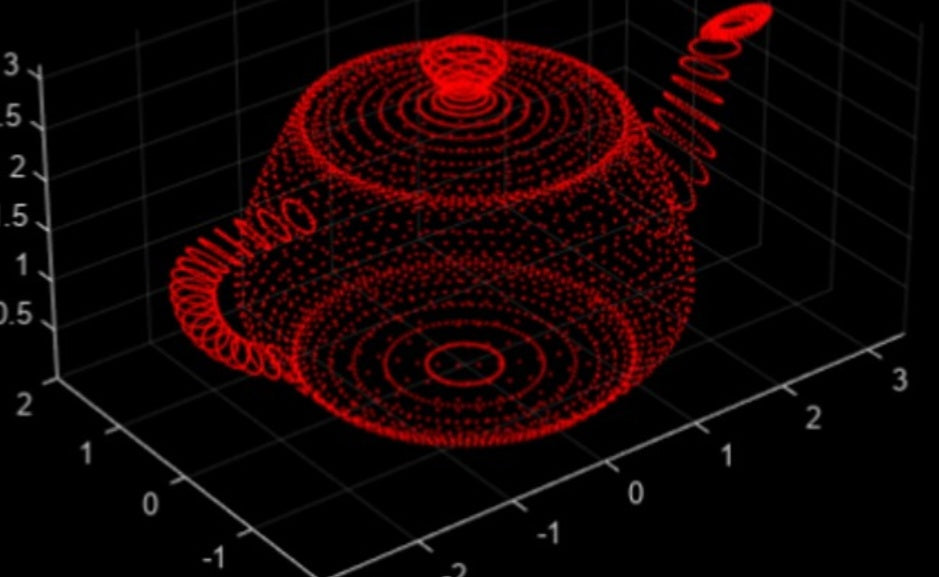
At its core, a point cloud is the most fundamental output of a 3D scanner.
Imagine taking a photograph, but instead of every pixel containing color information, every single pixel represents a specific coordinate in 3D space. When these millions of individual points are captured and rendered together, they form a highly detailed, three-dimensional representation of a physical object or environment.
Each point in this "cloud" carries an X, Y, and Z coordinate, often paired with data about its color or intensity, providing a digital map of the object's surface.
However, a point cloud is not a solid object; it is simply a collection of raw spatial data. Think of it as the "digital dust" that covers an object.
Because it lacks surfaces, edges, or true connectivity between points, you cannot perform traditional engineering tasks like calculating volume, checking wall thickness, or applying mechanical constraints directly to it.
The point cloud is purely descriptive—it shows you exactly where the surface of the object exists in the world, but it doesn't "know" that it is a part.
To make a point cloud useful for professional applications, it typically acts as the starting line. Once captured, this raw data must be processed: cleaned of environmental "noise," aligned into a coordinate system, and eventually meshed or modeled into a solid CAD body.
Understanding the point cloud is crucial because the quality of your final CAD model is entirely dependent on the density and accuracy of this initial capture. It is the raw material from which all precise, functional engineering designs are born.
Mastering the point cloud is about recognizing the difference between 'capturing' and 'designing.' While a 3D scanner can record the complex geometry of a car component or a broken plastic part in minutes, the point cloud itself is just the beginning.
By understanding how to manage this raw data—knowing when to increase density for fine details or filter out noise for cleaner surfaces—you take full control over your design process. This expertise ensures that the foundation of your project is as accurate as possible, setting the stage for a seamless transition into the solid modeling stage."


