
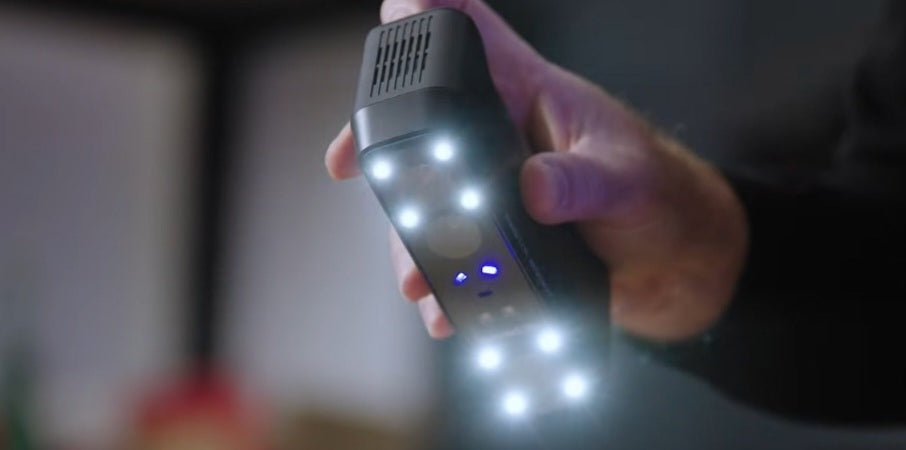
In 2026, the definition of a "portable" 3D scanner has shifted. It is no longer just about being small; it is about being truly independent. The best portable scanners today are "standalone"—meaning they feature onboard processing and built-in batteries, allowing you to walk around an object without being tethered to a laptop or cable.
Top Picks for 2026
If you are looking for the right tool, the market currently offers a range of scanners tailored to different experience levels and project requirements.
For beginners and hobbyists on a budget, the Revopoint INSPIRE 2 is an excellent, cost-effective entry point for standard household items. It’s lightweight, easy to handle, and perfect for learning the ropes of scan-to-print workflows.
For value-conscious makers, the 3DMakerpro Moose is a standout. It offers high precision and, most importantly, "AI-powered" markerless tracking. This makes it incredibly forgiving for those who find traditional scanning alignment difficult, particularly when working with mechanical parts.
For professional-grade convenience without the laptop tether, the Revopoint MIRACO Plus is currently one of the market leaders. As a fully standalone device with an integrated touchscreen, it allows you to scan, process, and export models entirely on the go—from workshop floors to outdoor locations.
If your work frequently involves automotive projects, the Creality CR-Scan Raptor or the EINSTAR Rockit are top-tier choices. These hybrid systems utilize both blue laser and infrared tech, allowing you to capture challenging metallic, dark, or reflective surfaces without the need for messy scanning sprays or complex setup.
For industrial-grade reliability where speed and metrology-grade accuracy are non-negotiable, the Artec Leo remains the gold standard. Its ability to provide professional-grade data capture with full wireless freedom makes it the premier choice for aerospace, automotive manufacturing, and high-end reverse engineering.
Key Considerations for Your Purchase
When selecting your scanner, remember that hardware is only half the battle. If you are regularly scanning car parts or shiny metal, Blue Laser is the gold standard because it handles those "difficult" surfaces with ease. Infrared (IR) scanners are generally better suited for matte objects and general-purpose projects where you want a faster, more forgiving workflow.
Furthermore, if you are scanning anything larger than a tabletop object, prioritize wireless, standalone devices. Being able to move freely without a cable connection is essential for maintaining tracking alignment on large, complex geometries.
Above all, don't just fixate on the highest resolution numbers; the best portable scanner is one that keeps its "lock" on the object, saving you hours of frustrating post-processing time.
The best portable 3D scanner aligns with your specific workflow. Whether you are replacing a broken legacy part or designing custom modifications for your vehicle, these tools are powerful enablers of creativity. Start with the hardware that fits your current goals, master your scanning technique, and you will find that the bridge between physical reality and digital design has never been shorter.


