
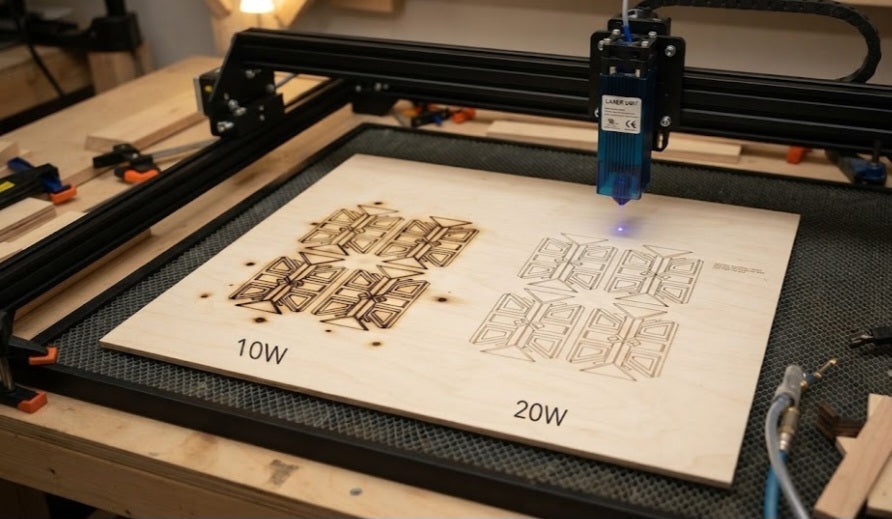
Choosing between a 10W and a 20W diode laser is one of the most common dilemmas for makers setting up a workshop. While a 10W laser is a capable entry point, a 20W machine promises significantly higher speed and cutting power.
To help you decide which setup fits your creative workflow, let's look at a comparative test across five common workshop materials.
The Five-Material Test Breakdown
Plywood (3mm Basswood or Birch):
10W Laser: Can cut cleanly, but usually requires multiple passes or a slower speed (around 300-400 mm/min) to get through cleanly.
20W Laser: Easily slices through 3mm plywood in a single, fast pass at higher speeds, dramatically cutting down production time.
Solid Hardwood (Walnut or Oak - 5mm):
10W Laser: Struggles with thicker hardwoods, often requiring 2 to 3 passes, which can increase charring along the edges.
20W Laser: Handles thicker cuts much more efficiently with cleaner edges due to higher energy density.
Anodized Aluminum (Engraving):
10W Laser: Produces crisp, deep marks on dark anodized aluminum at standard speeds.
20W Laser: Offers minimal visible difference in engraving quality compared to the 10W, though it can run at faster speeds with higher line intervals.
Clear Acrylic (Masked):
10W & 20W Lasers: Blue diode lasers (450nm) pass right through clear acrylic without engraving it directly. Both require a workaround (like masking or marking sprays), and neither is ideal for cutting clear acrylic natively.
Leather (Vegetable-Tanned, 2mm):
10W Laser: Great for surface engraving and clean cutting in one or two passes.
20W Laser: Cuts rapidly, but because of the high power, you must dial in your settings carefully to avoid burning or melting the edges.
Summary Verdict
Go with the 10W if you primarily focus on detailed engraving on wood, slate, and leather, and only do light, occasional cutting of thin materials.
Go with the 20W if your workflow depends on high-volume production, cutting thicker wood sheets regularly, and saving time on every project.
Ultimately, your choice between a 10W and a 20W diode laser comes down to balancing your budget against your throughput needs. By evaluating how frequently you cut thicker materials versus how much you value faster production times, you can select the machine that best supports your workshop goals.


