
Decoding the Clock: What is the Real 3D Printing Turnaround Time in South Africa?
When you are sitting on a fresh design, a broken bracket that needs an immediate replacement, or a prototype meant to pitch to an investor, waiting around is the ultimate bottleneck. One of the most common questions hitting local service bureaus and creators across the country is simple: How long is this actually going to take?
Navigating custom manufacturing locally means balancing material logistics, load-shedding realities, machine capacity, and queue positioning. Understanding what goes into a South African 3D printing turnaround time helps you plan your projects better, manage client expectations, and keep your workflow moving without frustrating delays.
The Anatomy of a Print Job Timeline
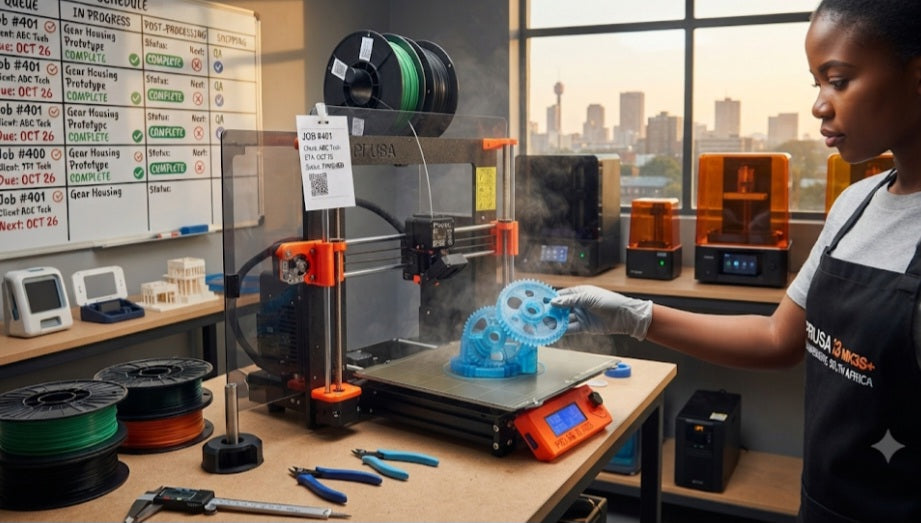
A common misconception is that the turnaround time is dictated solely by the machine's progress bar. If a digital model takes six hours to slice and print, clients often assume it will be ready in six hours. In reality, a professional production pipeline involves several sequential stages:
File Review and Pre-Processing:
Before a machine even heats up, a technician must inspect your STL, STEP, or 3D object file. This step involves checking for non-manifold geometry, wall thickness issues, or structural weak points, and generating optimized slicer settings.
Queue and Machine Allocation:
Depending on how busy a bureau is, your job enters a print queue. If your part requires specialized engineering filaments like carbon-fiber-reinforced nylon or flexible TPU, the machine might need a nozzle swap, bed re-calibration, or material drying before execution.
The Printing Phase:
This is where the physical layer-by-layer deposition happens. Large parts, high infill densities, or ultra-fine layer heights for smooth surface finishes can easily stretch a single print run past the 24-to-48-hour mark.
Post-Processing and Quality Control:
Once cool, the part has to be removed, support structures broken away or dissolved, and surfaces cleaned up. If you are working with resin printing, this includes washing in alcohol and UV-curing; for FDM, it might involve sanding, threading holes, or inserting brass heat-set threaded inserts.
What Local Factors Influence Turnaround Times in South Africa?
Running digital fabrication workflows in South Africa comes with a unique set of regional variables that commercial services factor into their delivery estimates:
Eskom and Power Stability:
While many modern production hubs utilize robust uninterruptible power supplies (UPS) and solar backup solutions, unexpected grid instability or stage-dependent power disruptions can occasionally pause long, high-precision prints. Reputable services build buffer time into their estimates to account for safe power transitions.
Material Availability and Import Lead Times:
Standard filaments like PLA, PETG, and general ABS are widely stocked locally in cities like Johannesburg, Cape Town, and Durban. However, if your project calls for specialized, high-performance polymers (like PEEK, Ultem, or specific abrasive composites), sourcing them can add days if local distributors are out of stock.
Shipping and Courier Transit:
If you aren't doing a direct local pickup, your physical location relative to the print bureau matters. Major metropolitan freight lines are generally fast, but regional or outlying delivery hubs can add an extra 2 to 4 business days to your final receipt time.
Standard Timeframes You Can Expect
To give you a realistic baseline for your planning or your own customer communications, turnaround windows generally fall into these tiers:
Rapid Prototyping / Single Small Parts:
Standard FDM prints under 100 grams typically clear production and QA within 1 to 2 business days.
Medium Batches & Complex Geometry:
Multi-part assemblies, intricate SLA resin items, or functional engineering prints requiring specialized materials usually take 3 to 5 business days.
Large-Scale Industrial Runs:
High-volume small batches or oversized prints requiring multi-day machine time scale out to 1 to 2 weeks, depending on queue depth.
How to Keep Your Projects on Schedule
If you want to shave valuable days off your production timeline, preparation is your best tool. Always supply clean, manifold CAD files rather than raw mesh scans that require extensive repair. Clearly communicate your functional requirements—such as whether the part needs mechanical strength, UV resistance, or thermal tolerance—right at the quote request stage. This eliminates back-and-forth emails and gets your file moving straight from the inbox onto the build plate.
Optimizing Your Production Pipeline for Faster Delivery
Mastering the mechanics of custom manufacturing requires a proactive approach to your entire workflow, going beyond simple print timelines. To truly optimize your turnaround times and scale your production efficiently, consider implementing these advanced strategies:
Adopt Standardized Slicing Profiles:
Maintain a library of pre-tested slicer profiles for your most frequently used filaments, such as standard PLA, tough PETG, and flexible TPU. Having dialed-in settings for retraction, temperature, and speeds eliminates guesswork and cuts down pre-processing time.
Implement Design for Additive Manufacturing (DfAM):
Design your models specifically with 3D printing constraints in mind. Minimize overhangs to reduce the need for excessive support material, orient parts to maximize Z-axis tensile strength, and incorporate chamfers instead of sharp 90-degree angles to prevent edge warping.
Establish Routine Maintenance Protocols:
Prevent unexpected machine downtime by scheduling regular maintenance checks. Keeping print beds leveled, nozzles clean, and drive gears free of plastic debris ensures your machines are always ready to run at a moment's notice.
Maintain Buffer Stock of High-Demand Materials:
Keep a well-managed inventory of your top-selling colors and engineering-grade polymers on hand. This eliminates reliance on rapid courier delivery for raw materials when a sudden rush order comes through.
Streamlining your custom manufacturing projects in South Africa is all about bridging the gap between digital design and physical reality. By accounting for local power realities, material supply chains, and proper pre-processing preparation, you can effectively manage production timelines and deliver functional parts without unexpected delays.


