
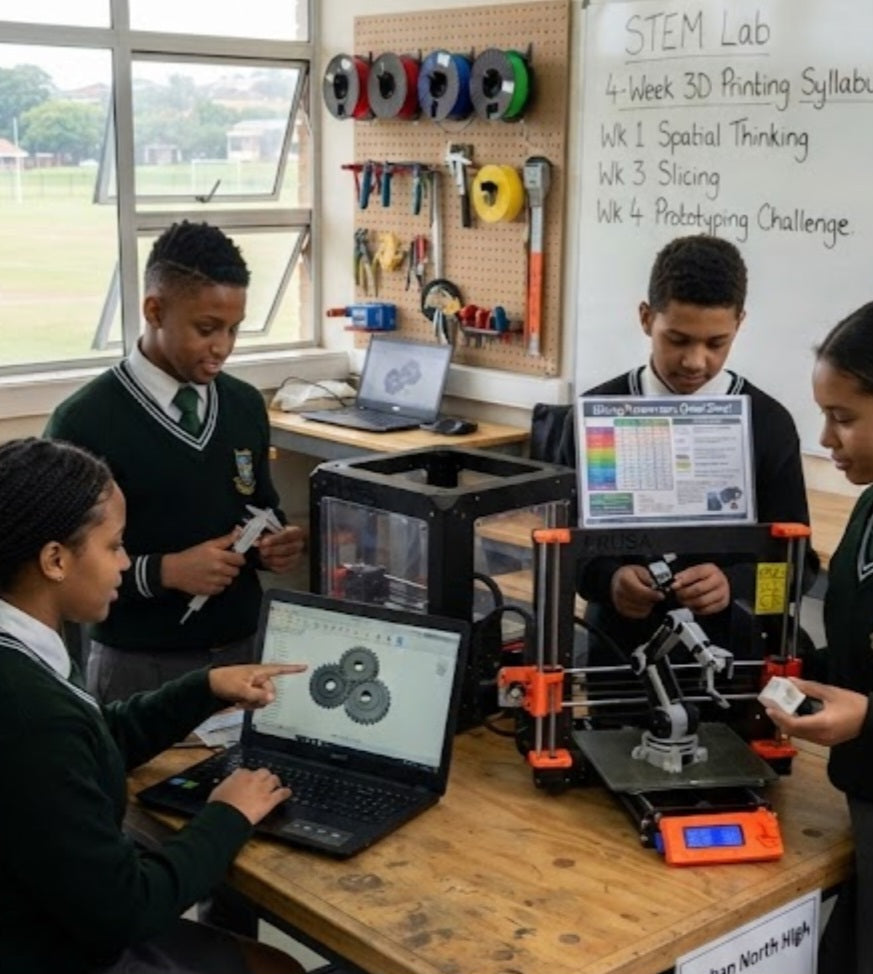
Introducing teenagers to computer-aided design and additive manufacturing is one of the most impactful ways to bridge theoretical school subjects with practical, real-world engineering. For South African educators working within constrained term schedules and Rands-based departmental budgets, a structured approach is essential to keep students engaged without overwhelming school resources. A well-designed introductory program moves learners smoothly from basic spatial visualization to holding their very own physical prototypes, building confidence and technical literacy step by step.
Week 1:
Foundations of Spatial Thinking and Basic Sketching: Teach students how to navigate simple browser-based or desktop CAD software, focusing on basic geometric shapes, coordinate planes, and dimensioning rules.
Week 2:
Tolerances and Parametric Modeling for Assembly: Guide learners through designing interlocking components, snap-fit joints, and functional clearances so they understand how digital parts fit together in the physical world.
Week 3:
Slicing Parameters and Material Optimization: Transition students from design software to slicers, teaching them how infill density, wall counts, and layer heights directly affect print time and filament consumption.
Week 4:
The Final Prototyping Challenge and Iteration: Conclude the module by having learners troubleshoot their own failed prints, analyze layer adhesion, and present a fully realized functional prototype.
Structuring a four-week syllabus requires careful balancing of computer lab time with hands-on machine operation to ensure that thirty students stay active and productive. During the first two weeks, emphasizing accurate dimensioning prevents frustrating alignment errors when parts are finally sent to the printer. Students quickly learn that digital precision dictates physical success; an extra millimeter or a tight tolerance can mean the difference between a smooth sliding joint and a fused, useless block of plastic.
As the course progresses into the slicer phase in week three, learners gain a deeper appreciation for manufacturing constraints such as overhangs, support material placement, and print orientation. This technical exposure aligns seamlessly with school technology curriculums, encouraging teenagers to think critically about material efficiency and structural integrity. By the final week, the iterative troubleshooting process instills professional resilience, teaching them that engineering is as much about analyzing and fixing failures as it is about initial design.
Bringing this comprehensive curriculum into your classroom equips teenagers with modern digital fabrication skills that prepare them for advanced technical education and future engineering careers. A structured four-week journey turns an intimidating piece of hardware into an accessible tool for creative problem-solving.


