
When setting up or maintaining your FDM 3D printer, one of the most fundamental hardware decisions you will make is choosing the material of your nozzle.
While nozzles come in various exotic metals, brass and hardened steel are the two most popular options on the market.
Understanding how these two materials differ in thermal conductivity, wear resistance, and cost will help you pick the right component for your filament choices and printing goals.
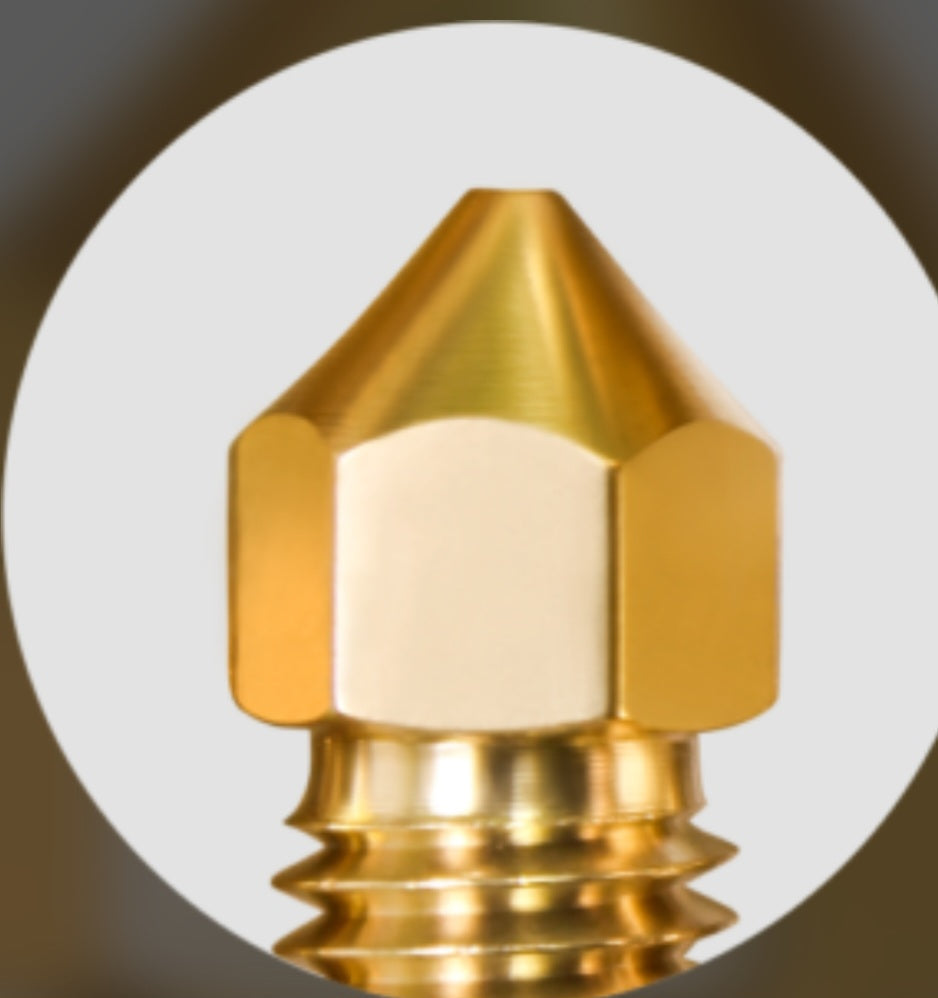
Brass Nozzles: The Industry Standard
Brass has been the default material for 3D printer nozzles since the early days of desktop manufacturing.
How It Performs: Brass is an exceptional thermal conductor, meaning it transfers heat from your heater block to the filament quickly and evenly. This allows for stable extrusion temperatures even at high printing speeds.
How It Performs:
Brass is an exceptional thermal conductor, meaning it transfers heat from your heater block to the filament quickly and evenly. This allows for stable extrusion temperatures even at high printing speeds.
Pros:
Highly affordable, widely available, and boasts excellent thermal conductivity for smooth, reliable printing with standard filaments.
Cons:
Brass is a relatively soft metal. It wears down quickly when printing abrasive composite filaments (like glow-in-the-dark, carbon fiber, wood-fill, or metal-filled plastics), which will widen your nozzle orifice over time and ruin print accuracy.
Hardened Steel Nozzles: Built for Abrasives
Hardened steel nozzles are engineered specifically to handle the brutal wear and tear of abrasive engineering materials.
How It Performs:
Steel is significantly tougher and more durable than brass, making it virtually impervious to wear from composite filaments.
Pros:
Extremely long-lasting and essential for printing abrasive materials filled with carbon fiber, glass fiber, glow powder, or metal particles. You can install one and practically forget about nozzle wear.
Cons:
Steel has much lower thermal conductivity than brass (roughly a quarter of the thermal transfer rate). This means you may need to increase your printing temperatures by 5°C to 15°C or slow down your print speeds to ensure the filament melts thoroughly as it passes through.
Key Comparisons to Consider
Filament Compatibility:
Use brass for standard, non-abrasive polymers like PLA, ABS, PETG, and TPU. Reserve hardened steel for any abrasive, reinforced, or specialty filaments.
Thermal Performance & Speed:
Brass wins on heat transfer, allowing for faster flow rates at lower temperatures. Hardened steel requires a bit more thermal compensation and slower speeds to prevent under-extrusion.
Maintenance & Lifespan:
Brass nozzles are cheap consumable parts that you will need to replace periodically if you print frequently. Hardened steel nozzles represent a one-time upgrade that lasts for years.
Balance your setup by using brass for everyday, high-speed polymer extrusion, and swap to hardened steel as a durable, long-term safeguard against abrasive composite wear.


