
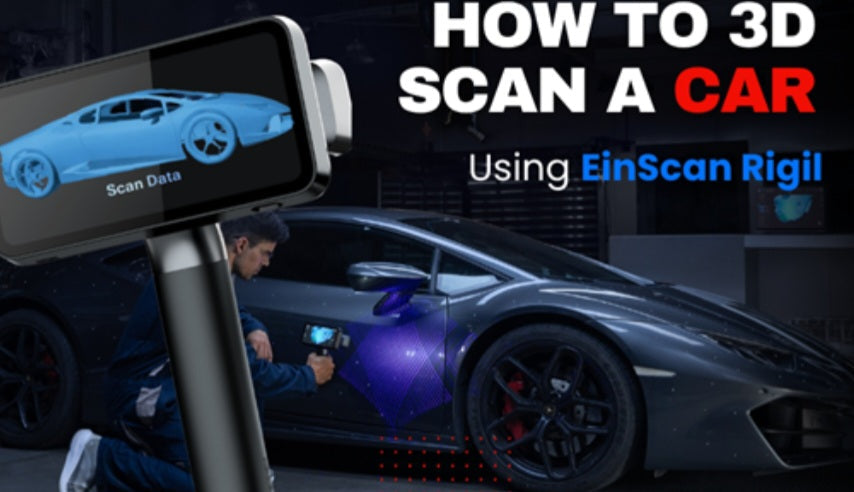
Can You 3D Scan a Car? (The Ultimate Garage Project)
Yes, you can 3D scan a car, but it is one of the most ambitious projects you can undertake with a 3D scanner. Whether you are reverse-engineering a custom body kit, creating a digital twin for a virtual build, or scanning specific interior trim, the process is as rewarding as it is challenging.
Scanning a full vehicle moves you from the realm of "simple desktop hobbyist" into "advanced technical scanning." Here is the reality of bringing a car into your digital workspace.
The Challenges of Automotive Scanning
Cars are essentially the "final boss" of 3D scanning objects for a few key reasons:
The Reflective Nightmare: Modern car paint and clear coats are designed to be mirror-like, and windows are transparent. Most scanners use light that bounces off these surfaces, resulting in "noise" or missing data.
Scale and Complexity: An entire car is massive compared to a standard scanning volume. Capturing the whole vehicle in one go requires professional-grade equipment or a highly methodical approach of stitching together dozens of smaller scans.
Symmetry and Lack of Features: Car bodies are often smooth, monochromatic, and symmetrical. Scanners use "features" (edges, corners, bumps) to orient themselves in space; without them, the scanner can get "lost" and cause alignment errors.
3 Tips for a Successful Car Scan
If you’re ready to take on this challenge, preparation is everything.
- Embrace the Spray: For the best results, use a temporary, vanishing 3D scanning spray. It turns shiny, transparent, or dark surfaces into a matte, scan-friendly finish and disappears on its own within a few hours. It’s the professional’s secret weapon for skipping hours of tedious "hole-filling" later.
2. Use Strategic Markers: Because car panels can be featureless, stick reflective target markers across the bodywork. These act as "anchors" that help your scanner software maintain its position in 3D space, preventing the dreaded "tracking loss."
3. Work in Sections: Don't try to capture the entire car as one giant file. Scan in logical, overlapping sections (e.g., the front bumper, the hood, the side panels). Modern scanning software is excellent at "stitching" or aligning these individual chunks into one cohesive model later.
The "Reference" Mindset
The most important thing to remember: A raw scan is not a finished part.
Your 3D scanner will provide a "point cloud" or a mesh—essentially a digital "ghost" of the car’s exterior. If you intend to 3D print a part that fits the car, you must import this scan into CAD software (like Fusion 360 or Shapr3D) to "reverse engineer" it. Use your scan as a precise 3D reference to build your custom part around, rather than trying to use the raw scan file itself as a final, printable object.
The Value of Professional Precision
Beyond the technical hurdles, the true advantage of scanning a vehicle is the ability to achieve a level of precision that traditional measuring tools—like tape measures or calipers—simply cannot provide. When you capture complex, organic curves and tight engine bay clearances as a high-fidelity digital model, you effectively eliminate the "guesswork" that usually plagues custom automotive fabrication.
This capability transforms your project from a trial-and-error process into a streamlined engineering operation. It allows you to prototype parts that fit perfectly the first time you print or machine them, significantly reducing waste and development time.


