
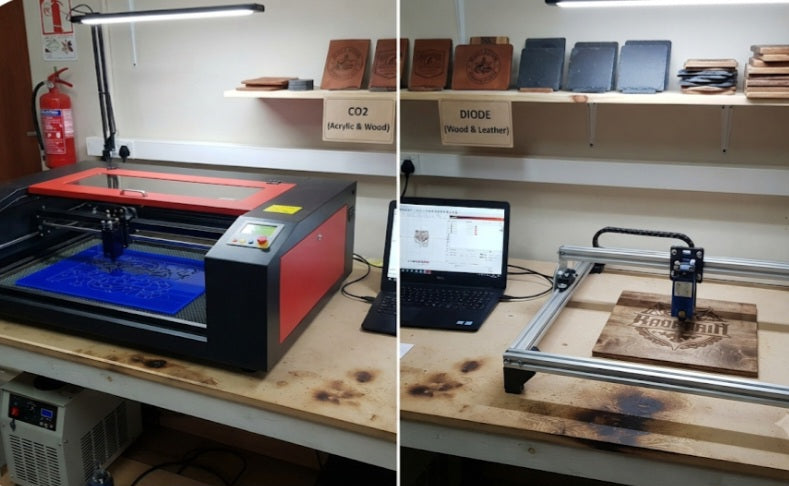
Choosing your first laser engraving machine is one of the most critical decisions you will make for your workshop. When starting out, you will primarily look at two options: Diode lasers and CO2 lasers. While both can cut and engrave, they use fundamentally different technology, handle different materials, and come with very different price tags.
Understanding how each machine operates will help you invest in the right tool for your specific business goals:
Diode Lasers (The Budget-Friendly Entry Point):
Diode lasers use semiconductor technology to produce a laser beam (usually in the blue light spectrum). They are generally much more affordable, compact, and require very little maintenance, making them popular for hobbyists and side-hustlers.
However, their main limitation is transparency and color: because of their wavelength, they struggle to cut or engrave clear acrylic, white plastics, or bare metals without special marking sprays, though they excel at engraving wood, leather, slate, and dark cardboard.
CO2 Lasers (The Versatile Industrial Workhorse):
CO2 lasers use a glass tube filled with carbon dioxide gas excited by electricity to generate an invisible infrared beam. They offer significantly higher cutting speeds, superior power, and clean edge finishes on thick timber.
Most importantly, a CO2 laser can cut and engrave a massive variety of non-metal materials—including clear and colored cast acrylic, fabric, glass, and rubber stamps—making it the ideal choice if you plan to launch a diverse e-commerce product line.
Power and Precision Trade-offs:
While high-end diode lasers now boast optical outputs of 20W to 40W, a CO2 laser (typically starting around 40W to 50W for entry-level enclosed machines like a K40 or OMTech) still outperforms them on speed and material compatibility, particularly for clear plastics.
However, CO2 lasers are physically larger, heavier, require an external water cooling system or chiller, and have glass tubes that eventually need replacement over time.
Maintenance and Lifespan Realities:
Diodes generally boast a much longer operational lifespan (often 10,000+ hours) with virtually zero maintenance besides cleaning the lens. CO2 glass tubes have a shorter lifespan (typically 1,000 to 2,000 hours), degrade over time even when idle, and demand careful alignment of their internal mirrors to keep the beam accurate.
Aligning Your Choice with Your Business Model:
If your startup plan focuses exclusively on rustic wooden items, leather patches, and slate coasters on a tight budget, a powerful diode laser is a smart, low-risk starting point.
If your product roadmap requires vibrant acrylic cake toppers, multi-material signage, and high-speed production, investing in an entry-level CO2 laser will save you from outgrowing your equipment too quickly.
Local Support, Safety, and Ventilation Considerations
Beyond upfront costs and material compatibility, factor in your physical workspace and local technical infrastructure. Open-frame diode lasers require strict use of laser-safety glasses and a dedicated ventilation setup to clear heavy smoke out of a home garage or spare room, whereas enclosed CO2 systems typically feature built-in exhaust fans and safety interlock doors.
Additionally, prioritize suppliers with physical stock and technical support within South Africa; having local access to replacement laser modules, mirrors, or power supplies prevents weeks of costly downtime if a component fails.
Choosing between a diode and a CO2 laser comes down to balancing your immediate startup budget against your long-term product roadmap. By carefully assessing the materials you plan to sell and your workshop environment, you can invest in the right machine to build a thriving e-commerce business.


