
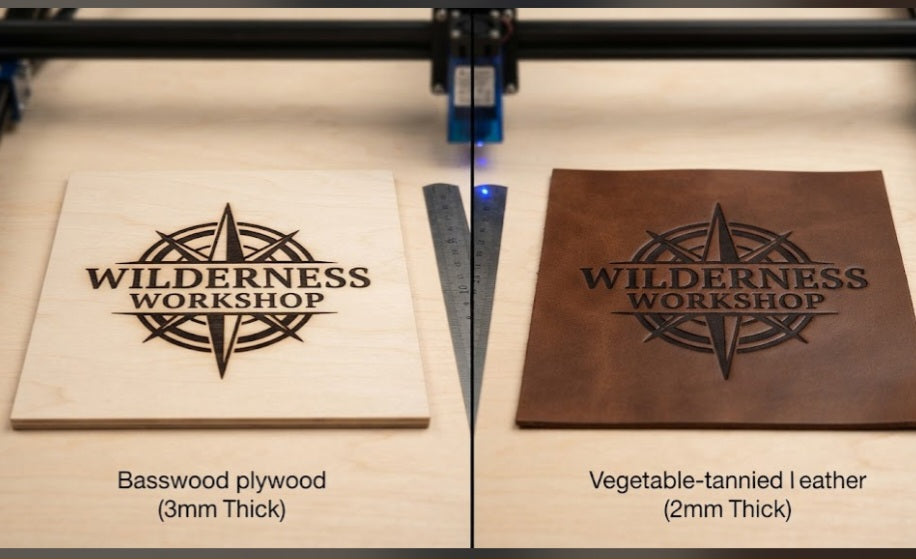
When expanding your product line or trying out custom branding, testing the exact same vector logo across different organic mediums is an essential step. Wood and leather are two of the most popular substrates for personalized gifts, yet they react completely differently to laser thermal energy.
To see how contrast, depth, and detail translate between these surfaces, let's look at a comparative photo test of a single logo burned onto both basswood and vegetable-tanned leather.
Material Response: Wood vs. Leather
Basswood Plywood (Surface Engraving):
Reaction:
Wood fibers contain cellulose and lignin, which carbonize into rich browns and deep blacks when exposed to a diode laser beam.
Visual Result:
The grain of the wood interacts with the vector lines, giving the logo a warm, rustic aesthetic with high contrast and sharp line definition.
Vegetable-Tanned Leather (Surface Engraving):
Reaction:
Leather responds aggressively to heat because of its organic tanning oils and proteins, burning much faster than wood at equivalent power settings.
Visual Result:
The logo takes on a debossed, dark brown or charcoal look with a rich tactile depth, though fine details can bleed if the power is set too high.
Optimizing Settings for Each Substrate
Power and Speed Calibration:
Wood:
Requires slightly higher power or lower speeds to punch through surface inconsistencies and achieve a uniform dark fill.
Leather:
Requires reduced power and faster speeds to prevent scorching or burning completely through thin hides, especially around tight vector corners.
Air Assist and Residue Management:
Wood:
Tends to trap smoke residue in fine crevices, making post-wiping with a damp cloth or sanding essential.
Leather:
Releases distinct natural oils and smoke that can stain surrounding areas, making masking tape protection crucial before running the job.
Deep-Dive: Vector Contrast and Detail Retention
Evaluating how a detailed logo handles shading versus clean vector lines reveals the unique limitations of both mediums. On wood, the hard cellular matrix maintains tight tolerances, allowing tiny text or intricate geometric patterns to stay crisp even at high speeds.
Engraving the same logo across wood and leather highlights how drastically different organic materials respond to identical vector data. By adjusting your speed, power, and post-processing steps for each medium, you can achieve consistent, high-end branding results across all your workshop projects.


