
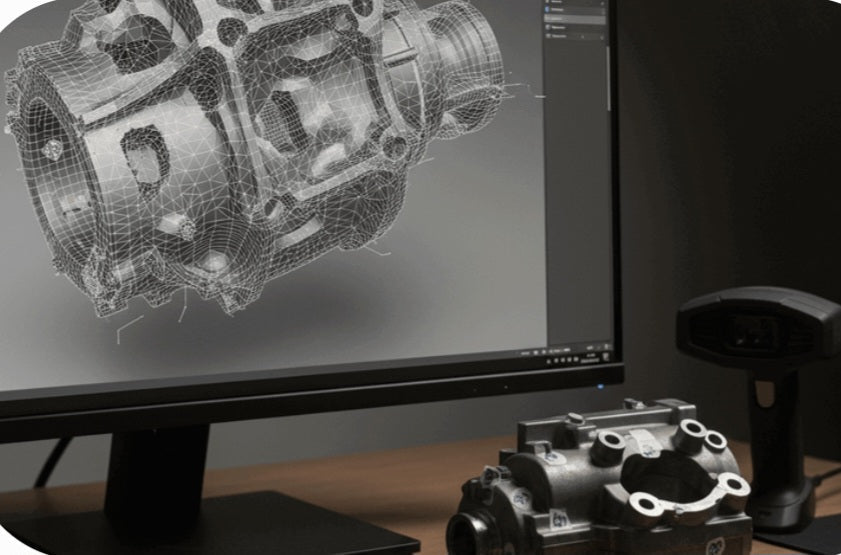
When setting up your 3D scanning station, the choice between a handheld unit and a desktop system often comes down to your primary subject matter and mobility needs. While both technologies are capable of producing high-quality data, they are optimized for very different tasks within the design and manufacturing pipeline.
Desktop 3D Scanners: The Precision Specialists
Desktop scanners—or "turntable" scanners—are designed for stationary, high-detail work. The object sits on a rotating platform while the scanner captures it from various angles, often with high-resolution cameras.
The Pros: They offer unmatched stability and automation. Because the environment and the distance from the sensor to the object are fixed, they produce highly consistent, clean data with minimal noise. They are the ideal choice for scanning small, intricate parts like jewelry, medical devices, or small mechanical components where every micron matters.
The Cons: You are strictly limited by the size of the turntable and the scanner's field of view. You cannot easily scan large objects like car body panels or engine blocks, and the setup is generally not portable.
Handheld 3D Scanners: The Freedom to Capture Anything
Handheld scanners are designed to be moved around the object, making them incredibly versatile tools for on-site projects or large-scale reverse engineering.
The Pros: They offer total freedom. Whether you are scanning a large car engine in a workshop or a human face for custom prosthetics, you aren't limited by a turntable or fixed mount. Modern handheld units, especially those with built-in screens and wireless capability, allow for real-time, on-the-spot scanning in almost any environment.
The Cons: They require more user skill to master. Because you are moving the scanner manually, you have to be mindful of your scan path and speed to avoid "tracking loss" or cumulative error. They generally demand a steadier hand and a bit more practice to achieve the same "perfect" data quality as a locked-down desktop rig.
Which One Should You Choose?
For South African professionals, the decision is usually based on the scale of your work. If you are a jewelry designer, an educator, or someone who focuses on small parts that fit on a desk, a desktop scanner is a time-saver that delivers perfect results every time. However, if you are working in an automotive workshop, construction, or any field where you need to scan objects larger than a standard PC monitor, a handheld scanner is a must-have for its sheer flexibility and mobility.


