
Which Should You Choose?
When shopping for a 3D scanner, you will quickly encounter two dominant technologies: Laser Scanning and Structured Light. While both tools use triangulation to capture 3D data, they operate differently and excel in different environments. Choosing the right one for your workshop in South Africa depends largely on what you are scanning and where you are doing it.
Structured Light Scanners: The High-Resolution Specialist
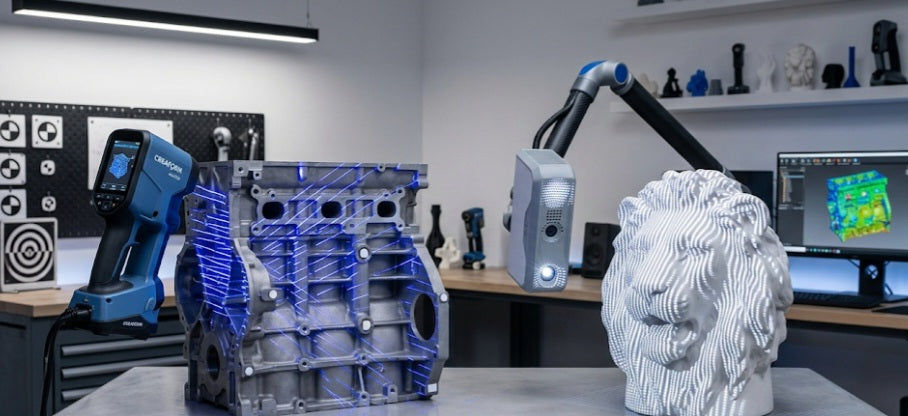
Structured light scanners work by projecting a series of light patterns (grids or stripes) onto an object. A camera records how these patterns distort across the surface, and the software reconstructs the geometry from those distortions.
The Pros: These scanners are incredibly fast and offer exceptional resolution, making them perfect for capturing fine details on complex, organic shapes or smaller items like jewelry and detailed figurines. Because they capture a wide "snapshot" in a fraction of a second, they are highly efficient for static, controlled studio work.
The Cons: They are sensitive to ambient lighting. Strong sunlight or bright workshop lights can wash out the patterns, and they often struggle with dark, transparent, or highly reflective surfaces, which may require you to use "scanning spray" to get a clean result.
Laser Scanners: The Industrial Powerhouse
Laser scanners function by projecting one or more laser lines onto the surface of an object. The reflection of that laser is measured by the scanner's sensor to create a 3D point cloud.
The Pros: Laser technology is significantly more robust. A high-end Blue Laser scanner can "cut through" difficult surfaces—such as shiny chrome, dark engine parts, or metallic finishes—without needing any surface preparation or spray. They are generally more reliable in challenging lighting conditions, making them the preferred choice for busy shop floors and automotive work.
The Cons: They are typically more expensive and can be more labor-intensive to operate, as they often require "painting" the object with laser lines. Additionally, they generally cannot capture color data as effectively as structured light systems.
Which One is Right for You?
If your goal is to digitize small, intricate, or colorful items in a controlled environment, a Structured Light scanner is likely your best bet. However, if your work revolves around automotive reverse engineering, industrial inspection, or scanning large metal components in a busy workshop, a Laser Scanner (specifically one with blue laser technology) is the professional standard. It will save you time by eliminating the need for surface sprays and provide the consistent, high-accuracy data required for mechanical assemblies.


