
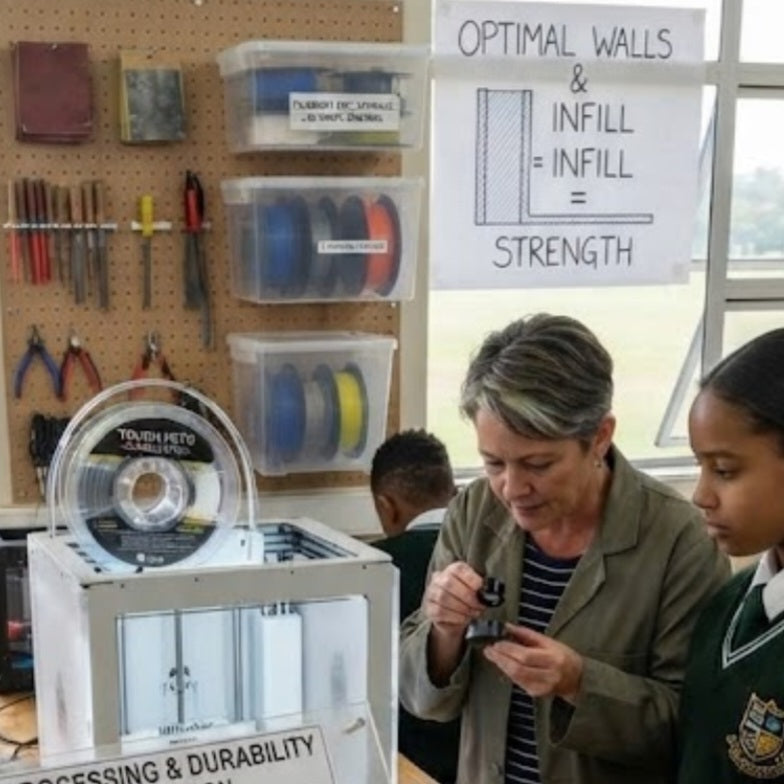
When learners spend hours designing a functional prototype in CAD, watching it materialize layer by layer on the classroom 3D printer is a moment of pure triumph. However, the true test of a school project happens the moment it leaves the maker space. If a student's custom gear assembly, mechanical linkage, or structural bracket snaps clean in half during the taxi ride home or collapses the first time a parent picks it up, the educational value takes an immediate hit. For South African educators operating on tight departmental budgets measured in Rands, making student prints robust enough to survive real-world handling is essential to prevent wasted materials and broken confidence.
Transition from Standard PLA to Tougher Polymer Blends:
While standard PLA is affordable and easy for beginners, upgrade functional or load-bearing student projects to PETG or high-impact PLA formulations that absorb mechanical shocks without shattering.
Optimize Wall Counts and Infill Density Settings:
Instruct slicing software to apply a minimum of three perimeter walls and 35\% infill using gyroid or cubic patterns, vastly increasing structural strength against drops and flex.
Design with Grain and Layer Orientation in Mind:
Teach learners that 3D prints are inherently weaker along the z-axis; orienting long pins, hooks, or levers flat on the build plate ensures mechanical forces act across strong continuous plastic strands rather than fragile layer lines.
Incorporate Generous Fillets and Radius Corners:
Eliminate sharp internal 90-degree corners in CAD models where stress concentrates, replacing them with smooth fillets to distribute impact forces evenly across the component.
Achieving true project durability also requires managing the environmental realities unique to our local climate, particularly regional humidity and thermal shifts. Moisture absorbed by open spools weakens plastic molecular bonds before the print even begins, resulting in brittle layers that snap under minimal pressure. Ensuring that filament is properly conditioned in sealed containers with silica gel keeps the extrusion uniform and strong. Furthermore, educating students on how ambient temperatures affect cooling rates helps them understand why letting a part cool slowly inside an enclosure prevents internal stresses from fracturing the final design.
By baking durability principles directly into the design phase, teachers ensure that student creations survive the journey out of the classroom and into the real world. A sturdy prototype doesn't just represent a successful grade; it proves to learners, parents, and school management that digital fabrication is a serious, industrial-grade capability worth investing in.
Finally, establishing a post-processing routine—such as a brief structural inspection or light sanding to remove sharp edges—ensures that every item leaving the school lab represents the highest standard of craftsmanship.


