
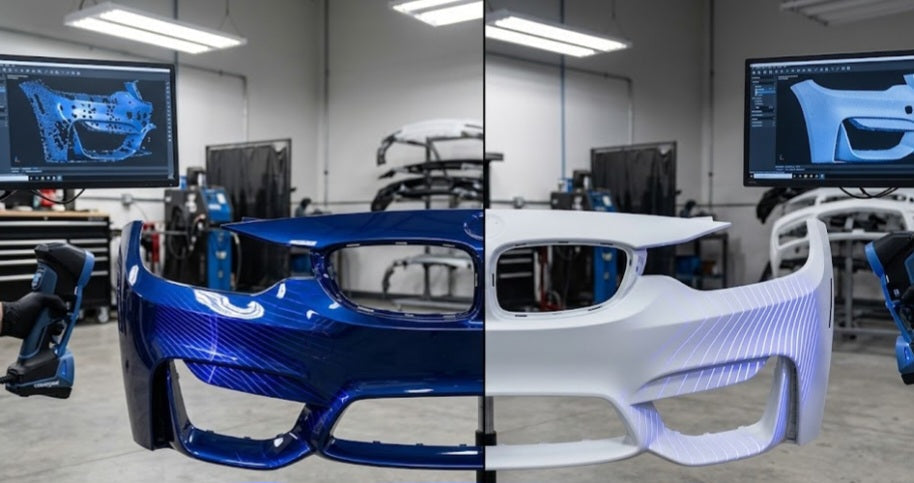
In automotive bodywork, aftermarket body kit development, and damage inspection, 3D scanning glossy automotive bumpers presents a classic optical dilemma. Fresh clear coats, high-gloss paint finishes, and polished chrome accents reflect projected laser lines and structured light patterns back into camera sensors at unpredictable angles, causing specular glare, signal saturation, and missing point data. Attempting to scan a high-gloss OEM front bumper in its raw factory finish often leads to severe tracking loss, noisy point clouds, and missing surface geometry across broad, curved sections.
To combat specular reflection, metrology technicians rely on specialized surface preparation techniques—ranging from temporary matting agents and sublimating (vanishing) scanning sprays to adjusting exposure and gain parameters on advanced blue-laser systems. Let's examine a side-by-side technical evaluation of scanning a glossy bumper with and without surface preparation, analyzing raw point cloud density, edge crispness, and total workflow efficiency.
Physics of Specular Reflection:
High-gloss automotive clear coats act as mirrors, causing direct specular reflection that blinds the scanner's CMOS sensors and destroys triangulation accuracy.
Unprepared Surface Performance:
Scanning raw glossy clear coats introduces optical specular highlights, stray point noise, missing patches on convex curves, and localized tracking dropouts.
The Impact of Sublimating Scanning Sprays:
Applying a micro-thin layer of cyclododecane or titanium dioxide spray transforms specular highlights into uniform matte white diffusion without permanently altering the original paintwork.
Laser Exposure and Sensor Gain Tuning:
Advanced blue-laser scanners allow software gain adjustments to handle mild reflectivity, but extreme gloss still benefits heavily from physical matting agents.
Step-by-Step Benchmark Testing Protocol
Evaluating the exact impact of surface preparation on a glossy automotive bumper requires a direct, controlled side-by-side testing procedure.
Part Mounting and Environmental Setup:
Secure the glossy automotive bumper onto a stable, vibration-damped mounting rack. Place hybrid reference targets along the perimeter support frame to ensure a consistent global coordinate system for both test runs.
Test Run A — Scanning Without Surface Preparation:
Sweep the unprepared, glossy bumper using standard blue-laser cross-line settings. Observe how specular reflections scatter laser energy, leading to incomplete point capture across central character lines and deep fog-light recesses.
Applying Sublimating Surface Prep:
Dust the bumper evenly with a ultra-thin layer of vanishing scanning spray (such as AESUB or Attblime). Ensure full coverage across high-gloss clear coat zones while keeping the layer thickness under 5 to 10 microns to avoid dimensional distortion.
Test Run B — Scanning With Matting Spray:
Sweep the prepared matte bumper using identical laser power and frame rate settings. Note how the uniform matte surface eliminates specular glare, allowing the scanner to capture unbroken, dense point clouds across every curve.
Deviation Heatmap Comparison:
Overlay both raw meshes in metrology inspection software (such as Geomagic Control X or PolyWorks) to quantify point cloud noise, edge definition losses, and surface thickness variations caused by spray build-up.
Post-Scan Cleanup and Residue Evaporation:
Monitor the vanishing spray as it completely sublimates into thin air over 2 to 4 hours, leaving the factory glossy bumper perfectly clean without requiring solvent washing.
Advanced Optical Dynamics and Layer Thickness Calibration
Eliminating specular glare, professional metrology requires precise coating thickness management. While permanent chalk sprays can leave uneven deposits up to 50 microns thick—introducing measurable dimensional errors in fine mounting tab alignments—modern sublimating scanning sprays produce self-leveling micro-layers measured in single-digit microns. In high-stakes automotive reverse engineering, maintaining sub-millimeter fidelity ensures that replacement splitter mounts or custom widebody fender flares fit flush against the original bumper during physical test fitting.
Comparing raw glossy bumper scans against professionally prepared surfaces highlights the critical role of surface prep in optical 3D metrology. While advanced multi-line blue lasers can handle mild reflectivity through gain manipulation, applying a thin sublimating scanning spray remains the gold standard for achieving pristine, noise-free point clouds and guaranteed CAD accuracy.


