
Which Method Should You Choose?
When you step into the world of professional 3D scanning and reverse engineering, you quickly realize that capturing an object is only half the battle. The core challenge of optical metrology is tracking: how does the scanner know where it is in 3D space from one frame to the next as you sweep it around a part?
Without a reliable tracking method, your software loses its frame of reference, resulting in a misaligned, jagged mesh or a complete loss of tracking tracking known as "losing the part." To solve this, manufacturers generally rely on two primary workflows: Target-Based 3D Scanning and Target-Free (Feature-Based) 3D Scanning.
Choosing between these two approaches can make the difference between a smooth, ten-minute data capture session and hours of alignment headaches. Let’s break down how each method works, their respective pros and cons, and when you should deploy them for your digital manufacturing projects.
What is Target-Based 3D Scanning? (The Sticker Approach)
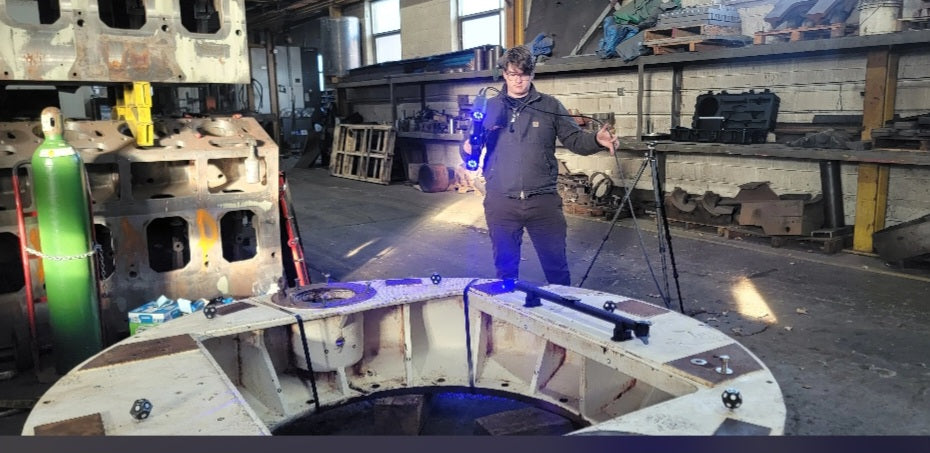
Target-based scanning relies on high-contrast reference markers—usually small, adhesive circular dots (often called targets or coded markers) strategically placed around or directly onto the object being scanned.
How It Works:
Optical 3D scanners are programmed to explicitly look for these specific circular geometric patterns. Because the relative distance between the dots never changes, the scanner uses them as fixed coordinate anchors in 3D space. As you move the scanner around, the software constantly triangulates its position relative to these markers, stitching every frame together with pinpoint precision.
The Global Alignment Advantage:
Targets create a rigid coordinate system. If you have to scan a massive object, flip it over, or capture a complex interior cavity where line-of-sight is lost, the targets maintain absolute global alignment, preventing cumulative error drift.
What is Target-Free 3D Scanning? (The Geometry Approach)
Target-free scanning—often referred to as feature-based or markerless scanning—relies entirely on the natural geometry, texture, and contours of the physical object itself.
How It Works:
The scanner's software analyzes organic shapes, sharp edges, holes, and unique surface features to match sequential frames. As long as there is enough unique geometry shifting across the camera’s field of view from one frame to the next, the software calculates the scanner’s relative movement on the fly.
The Plug-and-Play Benefit:
You don't need to prep the part with stickers or clean up residue afterward. You simply pick up the scanner, hit record, and start capturing.
Head-to-Head Comparison:
Pros, Cons, and Best Use Cases
Target-Based Scanning
Pros:
Exceptional Accuracy on Large Parts: Eliminates cumulative tracking errors over long distances.
Unforgiving Stability:
Highly resilient against tracking loss; if you lose line-of-sight, you simply point it back at a few targets to instantly resume.
Multi-Part & Stitched Assemblies:
Ideal for massive industrial components or full-vehicle scans where alignment stitching is critical.
Cons:
Prep Time:
Applying, positioning, and later removing sticky targets takes manual effort.
Surface Interference:
You cannot place targets on delicate, textured, or high-value cosmetic surfaces where adhesive might leave residue or damage the finish.
Target-Free Scanning
Pros:
Lightning-Fast Setup: Zero prep required—just place the part on the table and scan.
Cost-Efficient Workflow:
No consumables (like specialized optical dots) to constantly reorder.
Ideal for Organic & Complex Shapes:
Shines when scanning heavily sculpted, asymmetric, or feature-rich objects.
Cons:
Feature Starvation:
Struggles immensely with smooth, uniform, featureless geometries (like long flat sheets, simple cylinders, or spheres) because the software cannot find unique reference points.
Drift Risk:
Over very long scans or large objects, minor tracking errors can accumulate, leading to global misalignment.
Which Method Should You Choose for Your Project
To choose the right workflow for your next job, ask yourself three questions about your part:
How big is the object?
If you are scanning a small-to-medium component on a desktop rotary table, target-free scanning is usually fast and efficient. If you are mapping an entire car chassis, large machinery, or long structural frames, target-based workflows are essential to maintain dimensional accuracy.
Does the object have unique geometry?
If your part is full of sharp edges, cutouts, ribs, and pockets, target-free software will track it effortlessly. If the part is smooth, cylindrical, or symmetrical, you will likely need targets (or apply scanning spray with alignment markers) to give the software something to lock onto.
Is surface contact acceptable?
If you are working on a prototype where temporary sticker placement is fine, targets provide bulletproof reliability. If you are scanning a museum artifact, a delicate glass piece, or a finished product where cleanliness is paramount, target-free scanning is the only way to go.
The Bottom Line:
Mastering Both Worlds
Neither method is universally "better"—they are complementary tools in a professional metrology toolkit. Knowing when to lay down alignment targets for a massive industrial inspection versus when to rely on pure geometry for a quick reverse-engineering job will save you time, eliminate frustration, and guarantee clean, accurate data every single time.


