
You have your frame assembled, your stepper motors tuned, and your CAD software ready to roll. But as you stand looking at a wall of spindle options—ranging from a quiet 500W trim router all the way up to a massive 3kW water-cooled industrial beast—a heavy question hits you: How much power do I actually need?
It is one of the most debated topics in the maker community. Buy too little power, and your machine will stall, bog down in hardwoods, or take ten passes to cut a simple profile. Buy too much power, and you are dealing with unnecessary weight, heavy electrical requirements, and a motor so large it flexes your gantry.
In this deep dive, we are going to demystify CNC spindle power, explore the difference between hobby routers and industrial spindles, and help you find the absolute sweet spot for your workshop.
Routers vs. Spindles: Understanding the Difference
Before talking about wattage, we need to clear up a common point of confusion: Trimmers/Routers versus Spindles.
Trim Routers (e.g., Makita RT0701C, DeWalt DWP611):
These are brushed universal motors designed for handheld woodworking. They are loud, inexpensive, have integrated speed controls, and spin fast (up to 30,000 RPM). They operate as great entry-level CNC power sources because they are budget-friendly and easy to mount.
Dedicated CNC Spindles (Air-Cooled or Water-Cooled):
These are brushless AC induction motors paired with an external Variable Frequency Drive (VFD). They run exceptionally quiet, offer precise software-controlled speed regulation, maintain high torque across lower RPM bands, and are built to run continuously for hours in professional environments.
Breaking Down the Power Tiers:
Which One is Right for You?
Spindle power is generally measured in Watts (W) or Kilowatts (kW). Here is what each power tier can comfortably handle in a real-world workshop setting:
Under 500W (Micro Spindles / Rotary Tools):
Best for:
Light circuit board (PCB) milling, engraving plastics, foam, and delicate wood carving.
The Reality:
Far too weak for general woodworking or cutting plywood. Any heavy side load will stall the motor instantly.
500W to 800W (Entry-Level Trim Routers & Small Spindles):
Best for:
Light-duty desktop CNCs cutting thin softwoods, acrylics, and MDF.
The Reality:
Great for hobbyists starting out on smaller machines (like Shapeoko or 3018 upgrades), but you will need to take shallow depth-of-cut passes on harder materials.
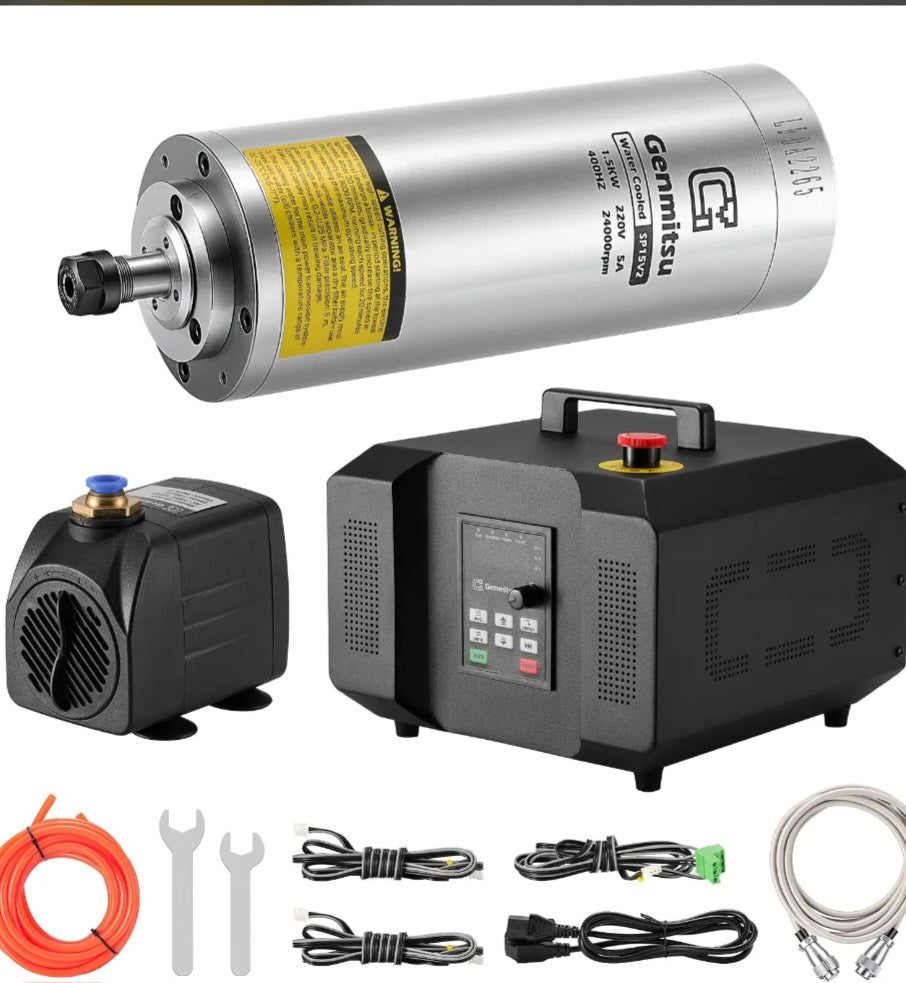
1.5kW (The Maker Sweet Spot - Approx. 2 HP):
Best for:
The ultimate balance for hobby-to-pro gantry routers.
The Reality:
A 1.5kW water-cooled or air-cooled spindle can comfortably drive a 1/4-inch end mill through hardwoods like oak and maple, high-density plastics, and even light aluminum passes without breaking a sweat. It runs on standard household current (110V/220V) and doesn't require industrial wiring.
2.2kW and Above (Industrial Powerhouses):
Best for:
Heavy production shops, full-sheet 4x8 cabinet routers, and deep-cut aluminum work.
The Reality:
These units usually require a 220V power supply and add significant weight to your Z-axis. Unless you are running production shifts or heavy non-ferrous metals, it is often overkill for a desktop or light gantry machine.
Factors Beyond Watts: RPM, Torque, and Rigidity
Power isn't just about wattage numbers on a spec sheet. Two other factors dictate how well your setup will perform:
Torque vs. RPM:
Routers rely on high RPM to shear wood fibers with small bits, but they lose torque at lower speeds. Dedicated spindles paired with VFDs allow you to maintain high torque even when slowing down your RPM—which is critical when cutting gummy plastics or hard metals.
Machine Rigidity:
A 3kW spindle on a flimsy 3D-printed or light aluminum extrusion frame is a recipe for disaster. Heavy power generates heavy cutting forces; if your machine frame isn't rigid enough to absorb those forces, you will experience severe chatter and poor surface finishes regardless of how powerful your motor is.
Choosing the right spindle power comes down to matching your motor to your materials and your machine's structural limits. For most desktop and mid-sized CNC makers, a 1.5kW spindle represents the golden standard—offering enough torque for hardwoods and aluminum without requiring heavy industrial infrastructure. Match it with proper feeds and speeds, and your machine will hum through projects smoothly every time.


