
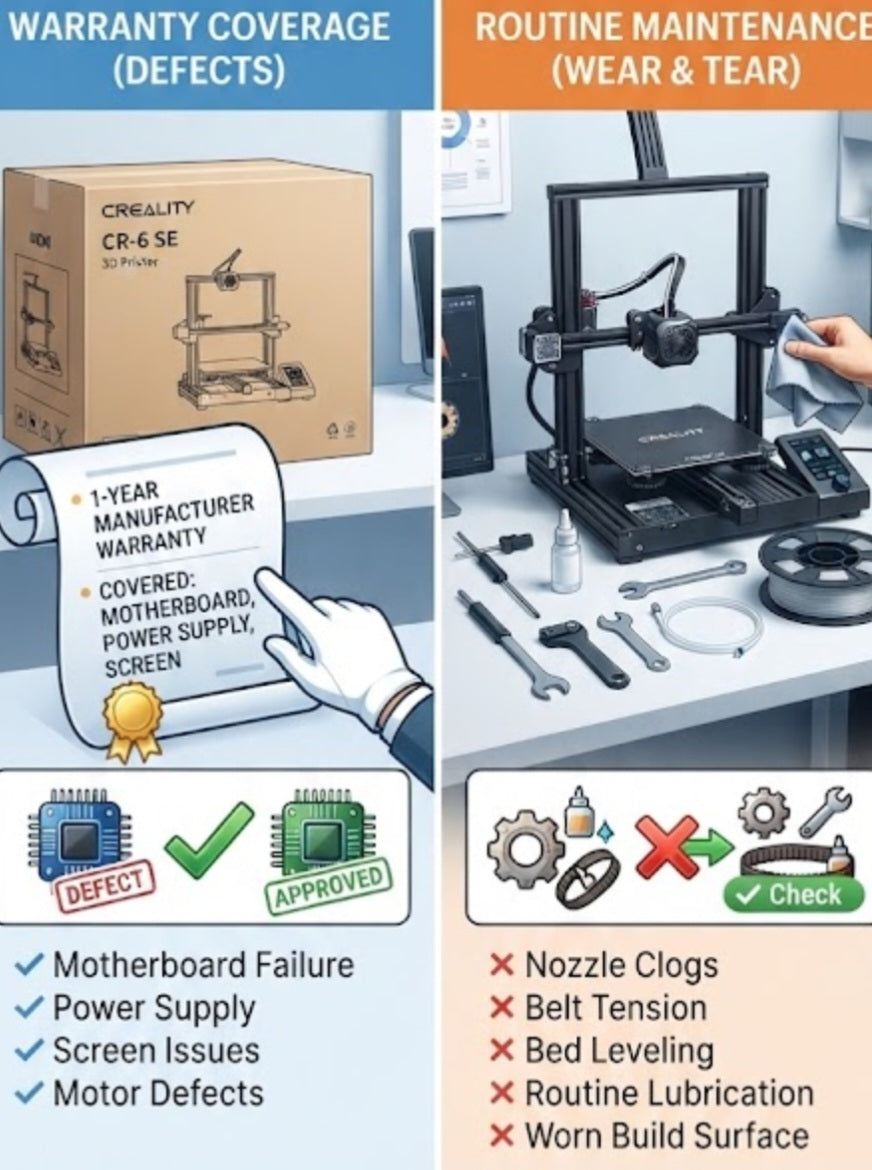
Navigating the ownership of a desktop 3D printer requires a clear understanding of where manufacturer backing ends and user responsibility begins. When a critical component fails, new makers often assume that any fault is automatically covered under warranty, only to find out that standard upkeep falls entirely on their own shoulders. Distinguishing between a genuine manufacturing defect and the natural wear-and-tear of operating high-precision machinery is essential for protecting your investment and keeping your workshop running smoothly.
Manufacturing Defects vs. Wear Items:
Warranties strictly cover premature electronic or structural failures caused by factory faults, whereas high-friction components like brass nozzles, PTFE tubing, and build surfaces are classified as consumable wear items.
The Cost of Neglecting Lubrication:
Failing to clean carbon buildup off the hotend or neglecting to lubricate lead screws and linear rails will void your claim, as poor maintenance is the leading cause of premature hardware breakdown.
Modifications and Firmware Risks:
Flashing unofficial firmware, hard-wiring custom toolheads, or bypassing safety limits instantly voids the standard factory guarantee on your mainboard and power supply.
Local Support and Freight Realities:
Understanding local supplier terms means knowing whether you are responsible for shipping a heavy machine back to the distributor for diagnostic testing during a warranty dispute.
When you invest in digital manufacturing equipment, the paperwork that comes in the box outlines strict boundaries regarding hardware longevity. A factory warranty is designed to protect you against faulty mainboards, defective stepper drivers, or improperly wired power supplies that fail right out of the box. However, it does not cover the routine realities of workshop use, such as clogged heatbreaks from running cheap filaments or mechanical misalignment caused by skipping your calibration checks. Treating your printer like a self-maintaining appliance is a fast track to unexpected repair costs.
Maintaining your machine proactively prevents minor friction issues from escalating into warranty-voiding catastrophes. Keeping linear guides clean, checking belt tensions, and replacing worn thermistors before they short out are standard duties every operator must handle. When you respect the boundary between factory accountability and daily upkeep, you extend the operational lifespan of your hardware and ensure your production line stays profitable.


