
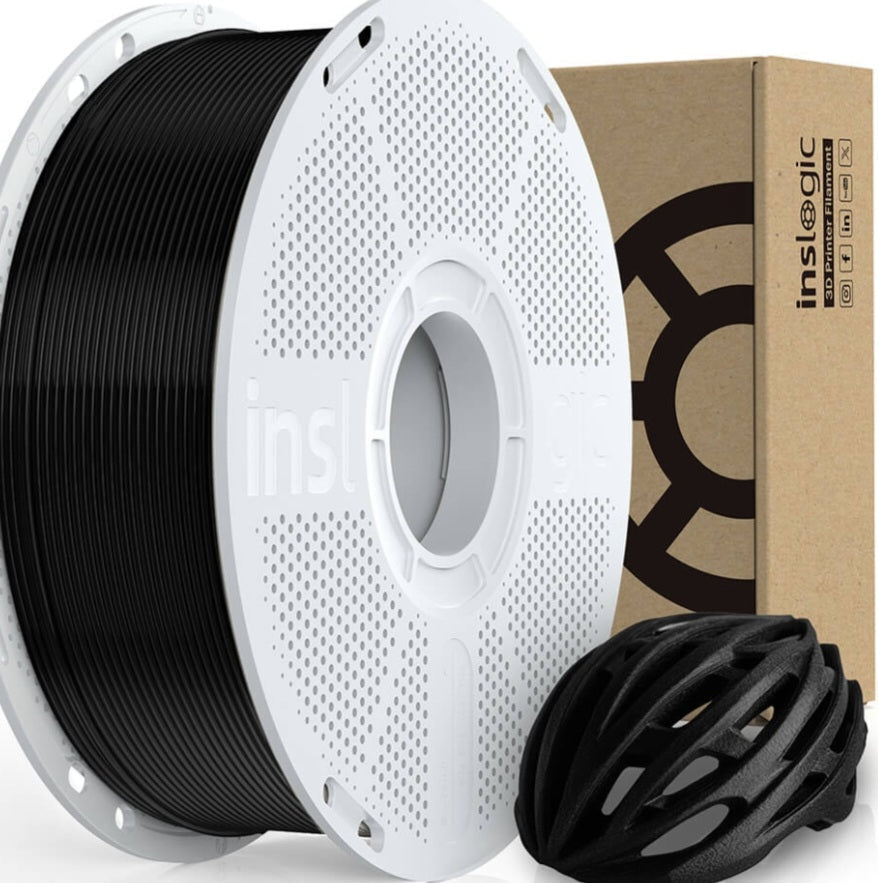
Which Filament Wins for Outdoor and Automotive 3D Prints?
When you graduate from indoor decorative prints to functional parts meant for real-world environments—such as under-the-hood automotive brackets, custom motorcycle parts, or weather-resistant outdoor enclosures—standard filaments like PLA and PETG often fall short. They can soften in the summer heat or degrade under intense sunlight.
This is where styrene-based engineering thermoplastics enter the picture. ABS (Acrylonitrile Butadiene Styrene) has long been a staple of industrial 3D printing, but ASA (Acrylonitrile Styrene Acrylate) was specifically engineered to overcome its predecessor's biggest flaw.
Comparing how these two powerful plastics handle outdoor exposure, mechanical stress, and printing mechanics will help you choose the ultimate material for your rugged projects.
UV Resistance and Weatherability (The Ultimate Showdown)
When parts are deployed outside or inside a vehicle cabin exposed to direct sunlight, ultraviolet (UV) radiation is the primary enemy.
ABS:
While ABS boasts fantastic mechanical strength and rigidity, its chemical backbone is notoriously vulnerable to ultraviolet light. When exposed to sunlight for prolonged periods, ABS undergoes photo-oxidation, causing the plastic to yellow, chalk, become extremely brittle, and eventually crack or disintegrate.
ASA:
ASA was literally invented to solve this exact problem. By replacing the butadiene rubber in ABS with an acrylic elastomer, manufacturers created a material with exceptional UV resistance. ASA withstands continuous direct sunlight, rain, and extreme temperature fluctuations without losing its structural integrity, color vibrancy, or surface finish.
Mechanical Strength, Rigidity, and Toughness
Both materials share a similar lineage, meaning their baseline mechanical performance is top-tier for engineering applications.
ABS:
Offers an incredible balance of rigidity, impact resistance, and tensile strength. It can handle heavy loads, flex slightly without snapping under sudden impacts, and easily tolerate being machined, sanded, or smoothed using acetone vapor.
ASA:
Mechanically, ASA matches or closely rivals ABS in almost every category. It provides high impact strength, excellent stiffness, and great load-bearing capacity. Because it doesn't degrade under UV exposure like ABS does, a structural part printed in ASA will actually retain its mechanical strength over years of outdoor use, whereas an ABS part would weaken.
Thermal Stability and Temperature Resistance
Automotive engine bays and sun-baked outdoor environments demand plastics that can handle elevated temperatures without warping or sagging.
ABS:
Features a glass transition temperature around 105°C. It handles engine heat, hot summer days, and warm enclosures quite well without deforming under load.
ASA:
Offers very similar thermal properties, maintaining structural stability up to roughly 95°C to 100°C. While it shouldn't be bolted directly against an active exhaust manifold, it easily survives dashboard temperatures in a parked car or sun-exposed outdoor machinery.
Printability, Warping, and Enclosure Requirements
Having high-performance material properties means very little if the filament is impossible to print reliably.
ABS:
Notorious for thermal contraction. Printing ABS requires a fully enclosed, heated or heat-trapping printer chamber to prevent rapid cooling. Without an enclosure, severe thermal gradients cause the corners to warp off the build plate and layers to split apart mid-print. It also emits strong styrene odors and VOCs that require proper ventilation.
ASA:
Shares nearly identical printing behavior with ABS. It demands a high bed temperature (typically 90°C to 110°C), an enclosure to maintain a stable ambient temperature, and good ventilation due to fumes. In fact, ASA can sometimes exhibit an even higher shrinkage rate than ABS, making draft-free enclosure control mandatory.
The Verdict:
Choose ABS if:
You are printing mechanical enclosures, indoor brackets, or props that will never see direct sunlight, or if you plan to rely heavily on smooth acetone vapor finishing.
Choose ASA if:
Your printed component is destined for the outdoors, a garden, a rooftop, a boat, or an automotive environment (like a custom grille piece, phone mount, or engine bay clip) where continuous UV exposure and weather resistance are non-negotiable.


