
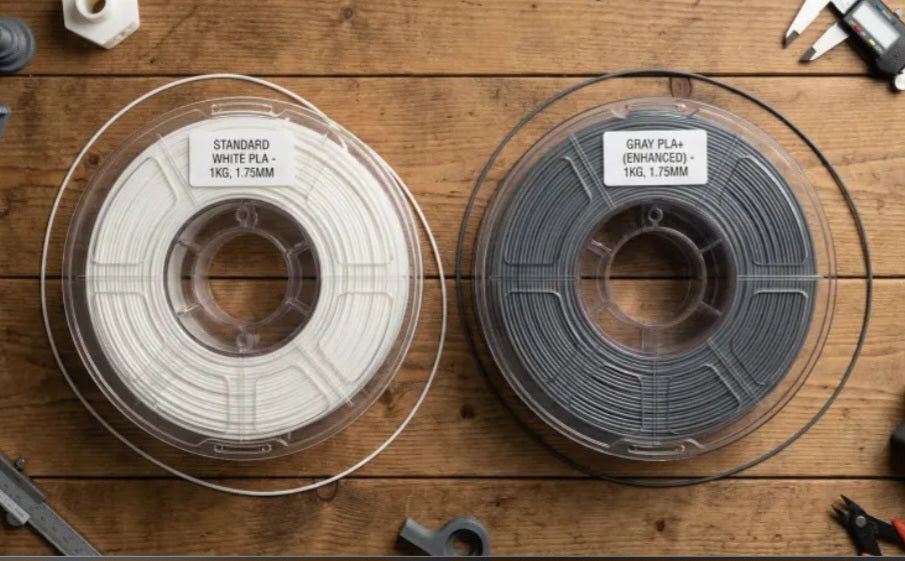
Is the Upgrade Worth It for Your 3D Prints?
When browsing for 3D printer filament, standard PLA is often the default choice for beginners and makers alike due to its low cost, ease of use, and beautiful surface finish.
However, standard PLA does have notable limitations—most notably its rigidity, which can translate to high brittleness and a tendency to snap under sudden impacts.
To counter these weaknesses, manufacturers introduced PLA+ (sometimes marketed as PLA Pro or PLA 2.0). But with a slightly higher price tag, the big question remains: Is PLA+ actually worth the extra investment?
Evaluating how these two materials compare across key performance metrics will help you determine which one deserves a spot on your spool holder.
Mechanical Strength and Impact Resistance
The most significant difference between standard PLA and PLA+ lies in how they handle physical stress and everyday wear.
Standard PLA:
While standard PLA features high tensile strength (meaning it resists stretching and maintains a rigid form under moderate loads), it lacks toughness. It behaves almost like glass under stress—hard and stiff, but prone to snapping or shattering instantly when dropped or heavily impacted.
PLA+: Formulated with proprietary additives and modifiers, PLA+ dramatically increases impact resistance and overall toughness. It absorbs significantly more shock energy before fracturing, meaning a functional part or mechanical component printed in PLA+ is far more likely to survive a accidental drop onto a hard floor.
Layer Adhesion and Interlaminar Strength
The boundary line where individual layers fuse together is often the weakest point of any FDM 3D print.
Standard PLA:
Standard PLA achieves decent layer bonding under optimal temperatures, but layer separation along horizontal planes remains a common point of structural failure under heavy strain.
PLA+:
One of the standout benefits of PLA+ is its superior inter-layer adhesion. The added plasticizers promote smoother melt flow and stronger molecular bonding between layers, allowing printed parts to behave more like a homogenous, uniform piece of plastic.
Heat Resistance and Thermal Stability
Neither material is designed to compete with high-temperature engineering plastics like ABS, ASA, or Nylon, but minor shifts in thermal tolerance can matter.
Standard PLA:
Standard PLA has a relatively low glass transition temperature, typically beginning to soften, warp, or deform around 50°C to 55°C. Leaving a standard PLA print in a sunlit room or a warm car will quickly result in catastrophic warping.
PLA+:
Many PLA+ formulations offer a slightly higher heat deflection temperature, sometimes pushing thermal resistance up by a few degrees or improving structural stability under minor loads. While it still cannot handle extreme environments, that small margin can occasionally prevent a part from failing in warm indoor settings.
Printing Experience and Post-Processing
A stronger material is only helpful if it remains user-friendly on the machine.
Standard PLA:
Renowned as the easiest material in 3D printing. It requires no enclosure, sticks effortlessly to almost any build surface, emits virtually no unpleasant odors, and prints reliably across a broad range of temperatures.
PLA+:
Keeps most of the beginner-friendly traits of standard PLA—requiring no specialized enclosure and exhibiting minimal warping. However, because of its unique chemical modifiers, it often demands a slightly higher nozzle temperature range (typically 200°C to 240°C) to achieve proper layer bonding and avoid under-extrusion.
The Verdict: Is PLA+ Worth It?
Choose Standard PLA if:
You are printing decorative miniatures, aesthetic display pieces, conceptual prototypes that will never face mechanical stress, or if you are simply learning the ropes of 3D printing and want a reliable, cost-effective filament.
Choose PLA+ if:
Your prints need to function in the real world. If you are creating brackets, clips, assembled mechanical components, toys, or items that will be handled frequently, assembled with screws, or subjected to minor drops, the massive boost in toughness and impact resistance makes PLA+ well worth the modest price difference.


