
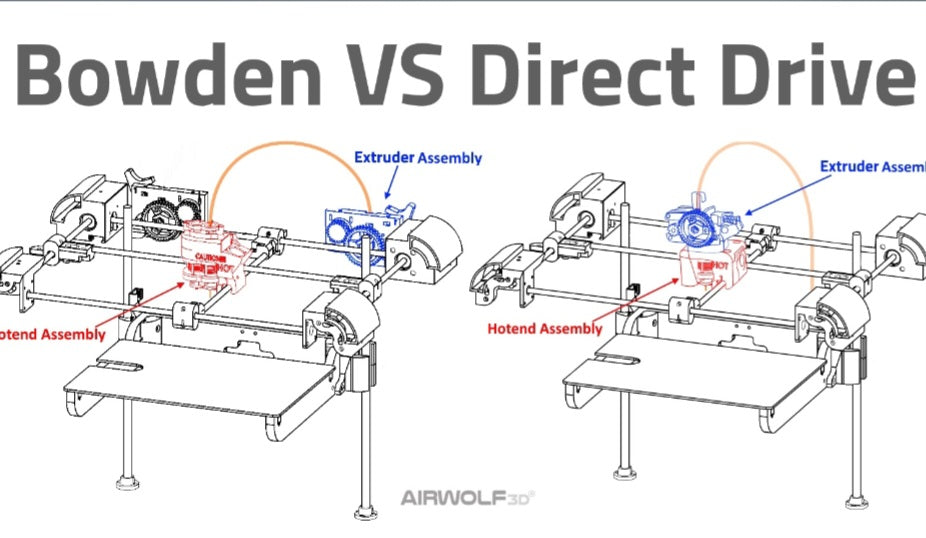
When configuring a 3D printer or choosing your next machine upgrade, one of the most critical hardware decisions you will face is the extrusion system. The extruder is the mechanical heart of your printer, responsible for gripping the filament and pushing a precise volume of plastic into the hotend melting zone.
For over a decade, the 3D printing community has been divided into two primary camps: Direct Drive and Bowden. Each architecture handles filament delivery through fundamentally different mechanical paths, completely altering how a printer performs with flexible filaments, retraction speeds, and acceleration tuning.
In this comprehensive guide, we will break down the engineering mechanics, pros, cons, and real-world performance differences between direct drive and Bowden extruders to help you decide which system best suits your fabrication workflow.
How They Work: The Architecture Difference
To understand their performance trade-offs, you first need to look at how each system physically transports filament from the spool to the nozzle.
Direct Drive Extruders:
In a direct drive setup, the motor and drive gears are mounted directly on top of the hotend. The distance between the grip gears and the melt zone is extremely short—typically just a few centimeters. The motor rides along the X-axis (or is part of the toolhead in CoreXY machines), moving back and forth across the build area.
Bowden Extruders:
In a Bowden setup, the heavy stepper motor is mounted remotely to the printer's frame. The filament is pushed from this stationary motor through a long, flexible PTFE (Teflon) tube—often 30cm to 60cm long—before finally entering the hotend mounted on the moving toolhead.
Flexible Filaments and Soft Materials
The physical distance between the drive gear and the hotend is the single biggest factor when printing flexible materials like TPU or TPE.
Direct Drive Superiority:
Because the filament travel distance is minimal and fully constrained inside a tight channel, direct drive systems excel at pushing soft, squishy filaments without buckling. The gear has immediate control over the extrusion pressure.
The Bowden Challenge:
Pushing a flexible noodle through a long PTFE tube creates immense friction. When the motor pushes, the soft filament tends to bow, expand sideways, and jam inside the tube rather than feeding smoothly into the nozzle. Printing flexible materials on a Bowden setup requires painfully slow print speeds and high clearance tolerances.
Toolhead Weight and Print Speeds (Inertia)
Physics plays a massive role in how fast your printer can change directions without introducing vibration artifacts like ghosting or ringing.
Bowden Agility:
Because the heavy stepper motor is bolted to the stationary frame instead of riding on the moving print head, the total moving mass (toolhead weight) is drastically reduced. This low inertia allows Bowden printers to achieve higher acceleration and speed limits without shaking the frame apart.
Direct Drive Inertia:
Modern direct drive extruders have become remarkably compact and lightweight (thanks to geared NEMA 14 motors and planetary gearboxes like the Bondtech BMG or Orbiter), but they still add more mass to the toolhead than a bare-bones Bowden hotend. While high-end motion systems easily compensate for this, ultra-light Bowden setups historically held an edge in raw directional agility.
Retraction Tuning and Stringing Control
Retraction is the process of pulling the filament backward slightly during non-print travel moves to prevent oozing and stringing.
Crisp Direct Drive Retractions:
Because the drive gears sit right above the heatbreak, a tiny retraction distance of 0.5mm to 1.5mm is usually enough to relieve pressure and stop oozing cleanly.
The Bowden Lag:
In a Bowden setup, the long PTFE tube acts like a spring. When the remote motor pulls back, it has to take up the slack and overcome friction inside the entire length of tubing before the nozzle actually stops extruding. This requires much larger retraction distances (4.0mm to 7.0mm) and slower speeds, increasing the risk of stringing and clogging if tuned incorrectly.
Selecting the ideal extrusion system ultimately comes down to balancing material versatility against motion dynamics.
While Bowden configurations historically dominated high-speed Cartesian architectures by stripping unnecessary mass off the gantry, contemporary engineering trends heavily favor direct drive.
The advent of lightweight planetary gearboxes has effectively bridged the weight gap, making direct drive the modern industry standard for reliable multi-material fabrication, effortless maintenance, and flawless string-free retractions.


