
The Physics of Speed: A Deep Dive into Input Shaping, Resonance Compensation, and High-Speed 3D Printing
We live in the golden age of desktop additive manufacturing. Only a few years ago, achieving clean prints meant keeping your speeds throttled down to a conservative 40mm/s to 60mm/s, forcing operators to wait hours for even modest components. Today, modern firmware and core-kinematics machines effortlessly smash past 300mm/s, 500mm/s, or even higher.
However, raw speed introduces a brutal physical adversary: inertia. When a heavy toolhead traveling at high velocities slams to a halt and reverses direction in a fraction of a millisecond, the physical frame of your printer shudders.
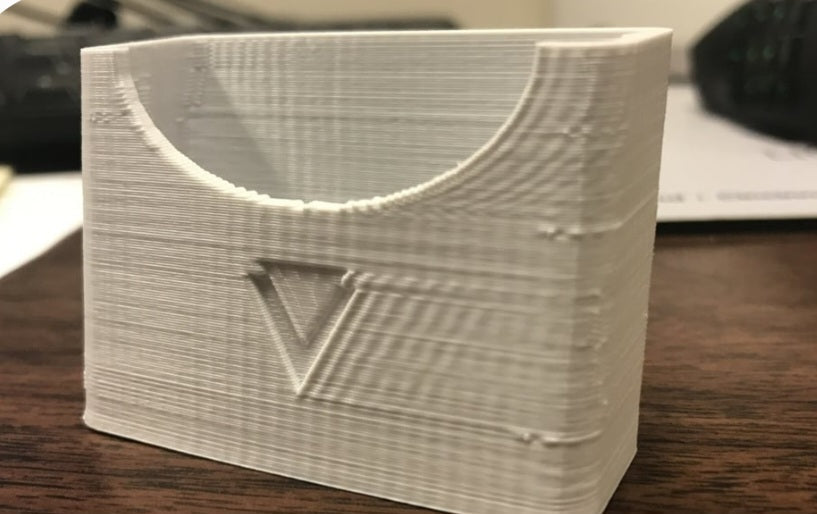
This mechanical oscillation manifests on your final prints as ringing, ghosting, or echoes—those frustrating, rippling surface artifacts that mimic seismic waves bleeding away from sharp corners and embossed lettering.
For years, combating ghosting required heavy hardware modifications: thickening aluminum extrusion profiles, tightening belts to guitar-string tensions, and adding massive cast-iron or concrete foundation blocks to absorb kinetic energy.
Input shaping provides a revolutionary software-level breakthrough that effectively cancels out mechanical vibration before it ever reaches the plastic."
The Anatomy of a Harmonic Vibration
To understand how input shaping works miracles, you first need to look at your 3D printer not as a rigid computer-controlled tool, but as a complex acoustic instrument.
Natural Frequency and Resonance:
Every physical object has a natural frequency—the specific rate at which it prefers to vibrate when struck or stressed. Your 3D printer frame, toolhead carriage, stepper brackets, and rubber-lined belts all possess distinct resonant frequencies.
The Tuning Fork Effect:
When your print head executes a rapid directional change, the sudden jerk excites these natural frequencies. The frame flexes microscopically, the belts stretch and snap back, and the nozzle wobbles off its intended mathematical trajectory.
Transferring Waves to Plastic:
Because this oscillation happens thousands of times per second during complex toolpaths, the vibrations transfer directly into the layer lines. Every time your printer negotiates a sharp corner, a wave propagates across the exterior wall, leaving diminishing ripples that look like a stone dropped into a pond.
Behind the Algorithm: How Input Shaping Defeats Physics
Rather than fighting a losing battle to make a lightweight aluminum-and-plastic machine completely rigid against high-speed forces, input shaping attacks the problem upstream at the motion controller level.
Mapping the Machine (Resonance Testing):
The process begins by discovering your printer’s unique resonant frequencies. This is typically done either automatically using a small USB accelerometer (such as an ADXL345 bolted to the toolhead and bed) or manually by printing a specialized tuning tower and measuring the distance between ringing waves.
The Mathematics of Cancellation:
Once the firmware (such as Klipper or RepRapFirmware) knows that your X-axis, for example, naturally resonates at 41 Hz, it builds a specialized signal processing filter. When the slicer sends a command for the toolhead to whip around a corner, the input shaper modifies that motion profile in real time.
Preemptive Counter-Pulses:
The algorithm injects microscopic, inverse control pulses fractionally ahead of the primary movement. These counter-vibrations push the toolhead in the exact opposite direction of the impending mechanical wobble. When the natural frame oscillation tries to throw the nozzle off course, the pre-programmed counter-pulse meets it head-on, effectively locking the nozzle dead-center on its intended vector through destructive wave interference.
The Different Flavors of Shaper Filters
Not all mechanical systems vibrate the same way, which is why input shaping algorithms come in several distinct mathematical variants. Choosing the right filter profile balances print quality against total print time.
MZV (Modified Zero Vibration):
This is the gold standard for most modern 3D printers. It provides excellent vibration suppression over a broad frequency range without sacrificing excessive print speed or causing undue smoothing of sharp corners.
EI (Zero Vibration Extra Derivative) and 2HUMP_EI:
For heavy, complex, or unusually flexible machines that suffer from multiple distinct resonance peaks, these advanced filters cast a wider net. They suppress complex harmonic vibrations across multiple frequencies, though they require a slightly higher trade-off in corner sharpness due to increased smoothing.
ZV (Zero Vibration):
The simplest and fastest filter, but it has a narrow bandwidth. If your machine's resonant frequency shifts slightly due to belt wear or temperature changes, basic ZV filters quickly lose their effectiveness.
Real-World Impact: What Input Shaping Changes for Makers
Implementing input shaping transforms your relationship with your hardware. It alters how you approach machine design, slicing profiles, and component upgrades.
Unleashing True High-Speed Flow:
You no longer have to compromise between structural integrity and surface aesthetics. You can crank up acceleration limits to 5,000mm/s^2 or 10,000mm/s^2 without turning your exterior walls into corrugated tin roofs.
Extending Machine Lifespan:
Because input shaping smooths out violent jerk spikes and abrupt directional transitions, it places less harsh mechanical shock stress on your bearings, lead screws, and structural joints, protecting your hardware from premature wear while operating at blistering speeds.
Input shaping represents one of the most elegant intersections of software engineering and mechanical hardware in modern manufacturing. By shifting the burden of vibration control from heavy physical reinforcements to intelligent, predictive firmware algorithms, it empowers desktop 3D printers to break past historical speed limits, delivering glass-smooth surface finishes even under extreme kinetic loads.


